


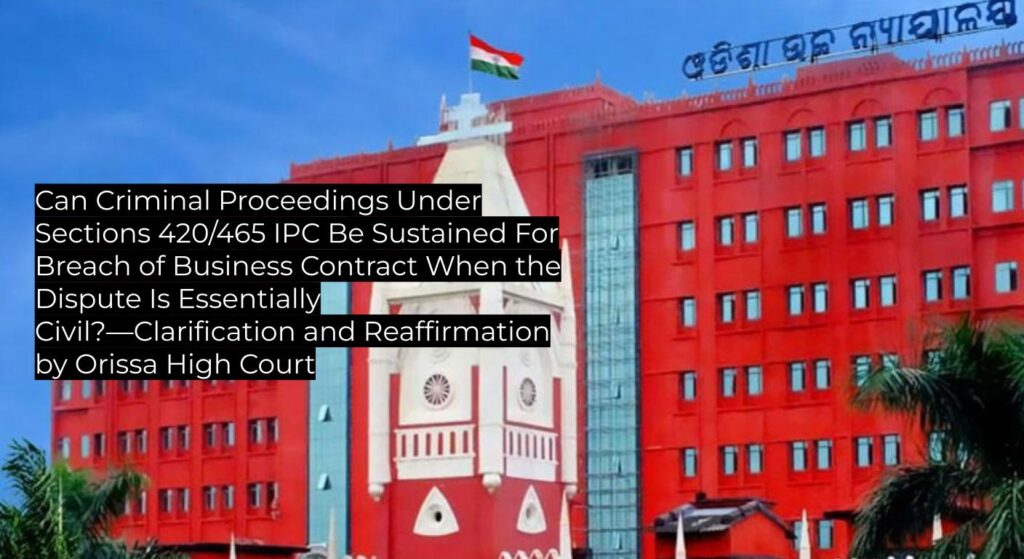
The Orissa High Court has reaffirmed that a mere breach of contractual obligations in a business transaction, without evidence of fraudulent or dishonest intent at inception, does not attract criminal liability under Sections 420 or 465 IPC. This judgment upholds established Supreme Court precedent, emphasizing that civil disputes should not be given a criminal colour, and serves as binding authority within the State of Odisha.
Summary
| Category | Data |
|---|---|
| Case Name | CRLMC/3086/2015 of NABRUN PATNAIK Vs STATE OF ORISSA |
| CNR | ODHC010521112015 |
| Date of Registration | 02-07-2015 |
| Decision Date | 24-10-2025 |
| Disposal Nature | Disposed Off |
| Judgment Author | MR. JUSTICE CHITTARANJAN DASH |
| Court | Orissa High Court |
| Precedent Value | Binding within State of Odisha; persuasive in other jurisdictions |
| Overrules / Affirms | Affirms existing Supreme Court precedent |
| Type of Law | Criminal Law / Criminal Procedure / Contract Law |
| Questions of Law | Whether alleged non-performance of a business contract can attract criminal liability under Sections 420/465 IPC, or is a purely civil dispute. |
| Ratio Decidendi |
The court held that to constitute cheating under Section 420 IPC, the complainant must demonstrate that the accused had a fraudulent or dishonest intent at the inception of the transaction. Mere breach of contract or failure to keep a promise later does not amount to cheating. The dispute in question was essentially civil and could not have been given a criminal colour. The High Court’s inherent powers under Section 482 CrPC can be invoked to prevent abuse of court process where the essential ingredients of a criminal offence are absent and a parallel civil remedy is being pursued. Complaint proceedings were thus quashed. |
| Judgments Relied Upon |
|
| Logic / Jurisprudence / Authorities Relied Upon by the Court |
The court applied the principle that inherent powers under Section 482 CrPC should be used to prevent abuse of process where proceedings are essentially civil in nature. It reiterated requirements established by the Supreme Court: to establish cheating, fraudulent intent at inception is necessary, and prosecution cannot sustain where a civil remedy is available and has already been pursued by the complainant. |
| Facts as Summarised by the Court |
The parties entered a business contract for supply of iron ore fines, supported by security cheques. Disputes arose regarding supply and payment. The petitioner claimed delivery of most contracted goods and sought unpaid amounts through civil litigation in Calcutta High Court, while respondent filed a criminal complaint for cheating/fraud. The complaint court took cognizance under Sections 420/465 IPC, which was challenged in this petition. |
Practical Impact
| Category | Impact |
|---|---|
| Binding On | All subordinate courts in Odisha |
| Persuasive For | Other High Courts and, where not directly covered, persuasive for Courts outside Odisha |
| Follows |
|
What’s New / What Lawyers Should Note
- Reaffirms that a dispute over business contract performance, without fraudulent intent at inception, cannot be prosecuted under Sections 420/465 IPC.
- Confirms High Courts’ power under Section 482 CrPC to quash criminal proceedings where a civil dispute is given criminal colour and civil remedies are already available and pursued.
- Clarifies that subsequent failure to fulfil a contract, even involving large sums or goods, cannot by itself establish criminal intention.
- Explicitly distinguishes between genuine criminality and civil breach, preventing misuse of criminal process as a tool of harassment in commercial disputes.
Summary of Legal Reasoning
- The court observed the factual scenario: business partners entered a contract for delivery of iron ore, and after substantial performance and disputes over remaining balance, both civil and criminal actions were pursued.
- It considered the existence of an arbitration clause and ongoing civil suit between the parties, noting that all disputes related to the transaction were being addressed in civil proceedings.
- The court cited Usha Chakraborty v. State of West Bengal and other Supreme Court precedents (Paramjeet Batra, State of Haryana v. Bhajan Lal, Kapil Aggarwal, Hiralal Harilal Bhagabati, Ajay Mitra), emphasizing that mere breach of contract or non-performance cannot amount to cheating or forgery under IPC unless fraudulent or dishonest intent at inception is present.
- The High Court underlined that inherent powers under Section 482 CrPC are to be used sparingly but are appropriate when criminal process is being misused for civil matters.
- After analyzing the allegations and materials, the court found no prima facie evidence of criminal intent and that the dispute was civil in nature.
- Consequently, it quashed the order taking cognizance under Sections 420/465 IPC.
Arguments by the Parties
Petitioner:
- The dispute arises from a business contract whose performance and obligations are governed by written agreement and subject to arbitration.
- All aspects of the matter are essentially civil; the order of cognizance under criminal law is unwarranted.
- The complaint fails to show any element of fraudulent or dishonest intent at the inception of the transaction.
Respondent (Opposite Party No. 2):
- Initially represented by counsel but subsequently not represented; the matter was heard ex parte on merits as no arguments were advanced.
Factual Background
The petitioner, Managing Director of M/s. Orex Minerals Ltd., and Opposite Party No.2, Managing Partner of M/s. Minex India, entered into a contract for supply of 7,800 metric tons of iron ore fines, supported by security cheques. After partial performance, disputes arose over remaining payments. The petitioner filed civil and criminal actions in West Bengal, while the respondent filed a criminal complaint for fraud and cheating before the S.D.J.M., Bhubaneswar. Cognizance was taken under Sections 420 and 465 IPC, leading to the present challenge.
Statutory Analysis
- Section 420 IPC (Cheating): The court interpreted that for cheating, there must be proof of fraudulent/dishonest intent at the inception of the transaction. Mere breach or non-performance later does not suffice.
- Section 465 IPC (Forgery): The court found the record did not support the essential elements for forgery in the business dispute context.
- Section 482 CrPC (Inherent Powers of High Court): Reaffirmed that this power is to prevent abuse of process of court or to secure ends of justice, especially where proceedings are essentially civil and the criminal process is used as a weapon of harassment.
- Civil Remedies and Arbitration Clause: The contract stipulated arbitration for disputes, and civil proceedings were ongoing, underlining the civil nature of the grievance.
Dissenting / Concurring Opinion Summary
No dissenting or concurring opinion was recorded in this judgment.
Procedural Innovations
No new procedural precedents, changes to evidence requirements, or suo motu guidelines were introduced in this judgment.
Alert Indicators
- ✔ Precedent Followed – The court has strictly followed and applied established Supreme Court precedent regarding the boundaries between civil and criminal liability in business disputes.