


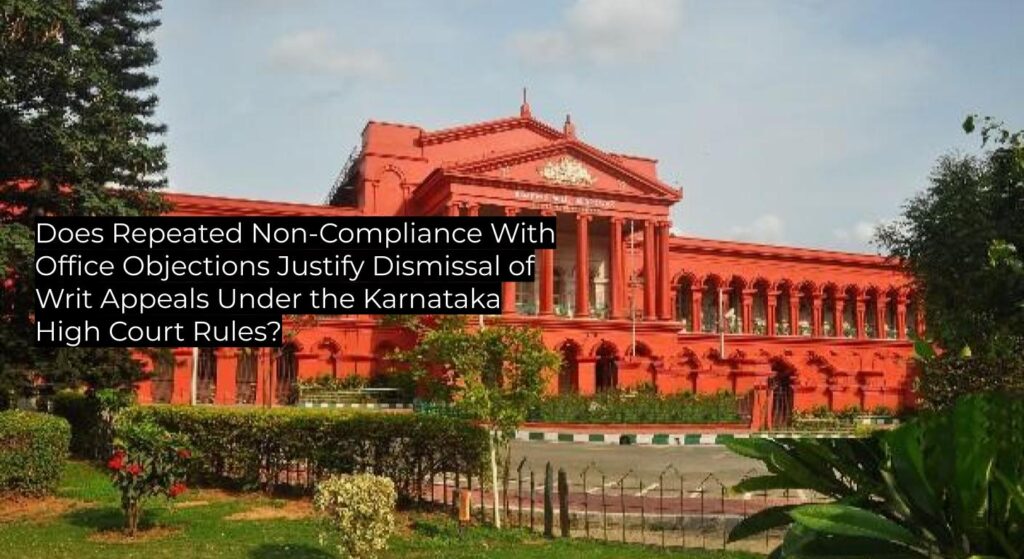
The Karnataka High Court reaffirms that persistent failure to remove office objections, despite repeated opportunities and imposition of costs, is valid ground for dismissal of appeals. The decision upholds established practice and serves as binding authority within Karnataka, providing clear procedural guidance for litigators.
Summary
| Category | Data |
|---|---|
| Case Name | WA/1539/2023 of SMT MUNIYAMMA Vs THE DEPUTY COMMISSIONER |
| CNR | KAHC010646732023 |
| Date of Registration | 08-12-2023 |
| Decision Date | 04-11-2024 |
| Disposal Nature | DISMISSED |
| Judgment Author | S.G. Pandit |
| Concurring or Dissenting Judges | Ramachandra D. Huddar |
| Court | High Court of Karnataka |
| Bench | Division Bench of S.G. Pandit and Ramachandra D. Huddar |
| Precedent Value | Binding within Karnataka High Court jurisdiction |
| Overrules / Affirms | Affirms established practice within the Karnataka High Court |
| Type of Law | Procedural Law (Compliance with office objections) |
| Questions of Law | Whether an appeal can be dismissed for repeated non-compliance with office objections, even after imposition of costs and multiple opportunities. |
| Ratio Decidendi |
The Court held that failure to comply with office objections, despite repeated listings and explicit grant of time (even subject to costs), defeats the purpose of such procedural safeguards. Payment of costs without compliance does not suffice, as the primary obligation remains removal of objections to move the judicial process forward. Dismissal is therefore appropriate in the absence of compliance, and such dismissal serves to uphold the integrity and efficiency of court procedure. |
| Facts as Summarised by the Court |
The appeal was filed on 05.12.2023. Office objections remained unaddressed through multiple opportunities—the matter was listed for compliance for the fifth time. On a prior occasion, two weeks’ time was granted subject to payment of costs. While costs were paid, office objections were not addressed, resulting in dismissal. |
Practical Impact
| Category | Impact |
|---|---|
| Binding On | All subordinate courts and litigants within the Karnataka High Court’s jurisdiction |
| Persuasive For | Other High Courts considering procedural dismissal for non-compliance |
| Follows | Affirms established internal practice and rules of the Karnataka High Court |
What’s New / What Lawyers Should Note
- The Court underscored that merely paying costs for delay does not excuse non-compliance with office objections—the core requirement remains removal of objections for the appeal to proceed.
- Continued non-compliance, even after repeated extensions and imposition of costs, will result in dismissal without further indulgence.
- Lawyers must vigilantly comply with procedural directions to ensure their matters are not dismissed on technical grounds.
Summary of Legal Reasoning
- The division bench considered the history of repeated listings (five occasions) for compliance with office objections, noting that even after a “final” time extension conditioned upon payment of costs, the objections were still not addressed.
- The Court clarified that payment of costs does not, by itself, satisfy the requirement to comply with office objections—the intent is to secure compliance, not merely penalize delay.
- Such non-compliance undermines judicial efficiency and the rationale for imposing costs or granting extensions.
- Accordingly, dismissal was found to be justified to preserve the proper functioning of court procedures and prevent abuse of process through repeated non-compliance.
- The decision affirms and applies the internal operating practice of the Karnataka High Court on this procedural aspect.
Arguments by the Parties
Appellant
- Sought further time to comply with office objections, citing payment of the previously imposed cost.
Factual Background
The appellant filed a writ appeal on 05.12.2023. The High Court registry raised certain office objections to the appeal. The matter was listed five times to allow removal of these objections, with the last extension being “final” and conditioned upon payment of a cost of Rs. 3,000 to the Advocates’ Welfare Fund. While the cost was paid, the office objections were not rectified, leading to the dismissal of the appeal for non-compliance.
Statutory Analysis
- The Court operated under procedural rules governing compliance with office objections in writ appeals within the Karnataka High Court.
- The judgment did not refer to or interpret any substantive statutory provisions, but strictly applied its procedural standards regarding office objections and dismissal for non-compliance.
Dissenting / Concurring Opinion Summary
No dissenting or separate concurring opinions are recorded in the judgment.
Procedural Innovations
The judgment did not introduce any new procedural rules but reaffirmed the necessity for compliance with existing procedural requirements regarding office objections and the consequences of non-compliance.
Alert Indicators
- ✔ Precedent Followed – The judgment affirms existing procedural law and internal practices regarding compliance with office objections within the Karnataka High Court.