


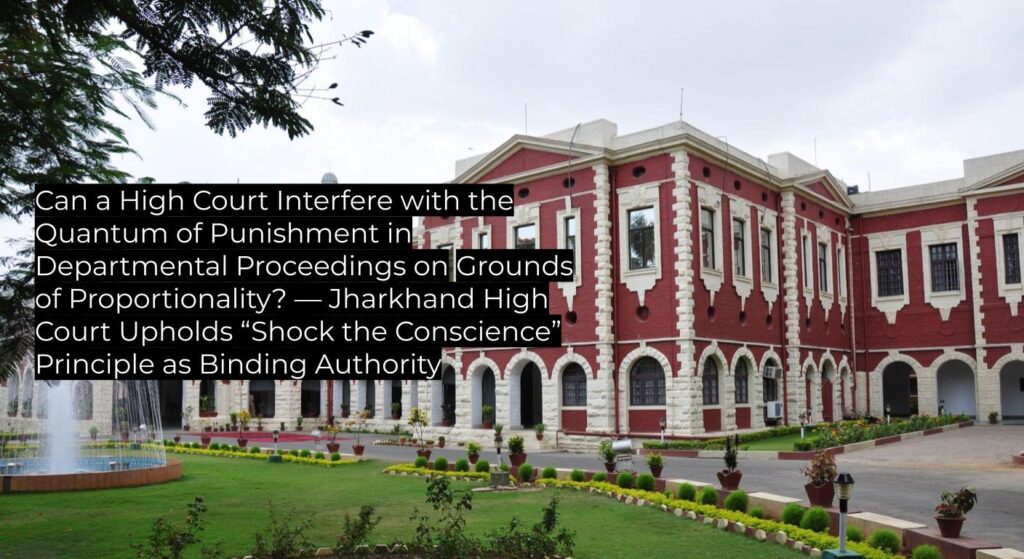
A Division Bench of the Jharkhand High Court affirms that courts may interfere with departmental punishment only when it is “shockingly disproportionate” to the charges, and reiterates that remittal for reconsideration (rather than substitution of punishment) is the correct course; precedent value reaffirmed for all public service and disciplinary proceedings within the State.
Summary
| Category | Data |
|---|---|
| Case Name | LPA/134/2025 of THE STATE OF JHARKHAND THROUGH THE PRINCIPAL SECRETARY, DEPARTMENT OF SCHOOL EDUCATION AND LITERACY Vs MEENA KUMARI RAI |
| CNR | JHHC010340672024 |
| Date of Registration | 03-03-2025 |
| Decision Date | 15-10-2025 |
| Disposal Nature | Dismissed |
| Judgment Author | HON’BLE MR. JUSTICE SUJIT NARAYAN PRASAD, HON’BLE MR. JUSTICE ARUN KUMAR RAI |
| Court | High Court of Jharkhand |
| Bench | Division Bench (Justice Sujit Narayan Prasad and Justice Arun Kumar Rai) |
| Precedent Value | Binding within the State of Jharkhand; persuasive authority for other courts |
| Overrules / Affirms | Affirms Single Judge’s decision and Supreme Court precedents (Union of India v. P. Gunasekaran; CISF v. Abrar Ali) |
| Type of Law | Service Law / Administrative Law (Disciplinary Proceedings) |
| Questions of Law | Whether judicial review can be exercised by High Courts to interfere with the quantum of punishment imposed in departmental proceedings solely on the ground of proportionality; when such interference is justified. |
| Ratio Decidendi | The High Court, exercising judicial review, may interfere with the quantum of punishment in departmental proceedings only if the punishment is so disproportionate to the gravity of the charges that it shocks the conscience of the court. Courts must assign reasons when so holding, but cannot substitute punishment; the matter must be remitted to the disciplinary authority for reconsideration. The entire service record, nature of charges, and absence of allegations involving embezzlement or loss to revenue are relevant factors. Precedents of the Supreme Court restrict High Courts from acting as appellate authorities or re-appreciating evidence. |
| Judgments Relied Upon |
|
| Logic / Jurisprudence / Authorities Relied Upon by the Court | Judicial review limited to the grounds of perversity, violation of principles of natural justice, or when punishment shocks the conscience; re-appreciation of evidence and substitution of punishment not permitted. |
| Facts as Summarised by the Court | Respondent, a DEO with 31 years’ unblemished service, was removed for alleged administrative lapses (not monetary irregularity or dishonesty). The Single Judge found the punishment disproportionate and remitted to the disciplinary authority. The State appealed, arguing the charge was proven and punishment appropriate; respondent relied on her record and disproportionality. The Division Bench, relying on Supreme Court guidelines, affirmed the Single Judge’s order. |
Practical Impact
| Category | Impact |
|---|---|
| Binding On | All subordinate courts and authorities within the territorial jurisdiction of the Jharkhand High Court |
| Persuasive For | Other High Courts and the Supreme Court in interpreting proportionality in disciplinary actions |
| Follows |
|
What’s New / What Lawyers Should Note
- Reinforces that High Courts can intervene on quantum of punishment only if it “shocks the conscience” and is disproportionate to the proven charges.
- Specific and cogent reasons must be recorded by the court to justify interference on proportionality grounds.
- Even where interference is justified, courts must remit the matter for reconsideration by the disciplinary authority rather than substituting their own punishment.
- The entire service record and lack of grave dishonesty or embezzlement are relevant in proportionality assessment.
- Lawyers should highlight long unblemished service, nature of charge (administrative vs. penal/moral turpitude), and absence of monetary loss when challenging extreme penalties.
Summary of Legal Reasoning
- Supreme Court Framework: The court applied the principles laid by the Supreme Court in P. Gunasekaran (2015), CISF v. Abrar Ali (2017), and State Bank of Bikaner (2011), circumscribing High Court powers as not acting as appellate authorities in disciplinary proceedings.
- Grounds for Interference: Judicial review over disciplinary punishment is only justified if (a) the punishment is shockingly disproportionate to the charge (shocks the conscience), (b) findings are based on no evidence, or (c) there are gross procedural violations.
- Proportionality Principle: The Division Bench agreed with the Single Judge that removal from service, especially for an officer with 31 years’ unblemished record and no evidence of grave or criminal misconduct (e.g., no embezzlement or loss to revenue), was disproportionate.
- Remedial Mechanism: The proper course, in such circumstances, is remitting the case to the disciplinary authority, not substituting the court’s own penalty.
- Factual Appraisal: The Bench stressed that only administrative lapses (laxity in duty, not dishonesty) were established, and noted the approaching retirement of the respondent.
- Conclusion: No error in the Single Judge’s proportionality assessment; thus, the appeal failed.
Arguments by the Parties
Petitioner (State/Appellant)
- The inquiry officer fully proved the charges against the respondent.
- The respondent was in a position of significant accountability (DEO).
- The punishment of removal is not disproportionate due to the serious nature of lapses.
- Single Judge erred in interfering with the punishment.
Respondent (Employee)
- The charges were not of grave or criminal nature; mainly administrative.
- The Single Judge assigned specific reasons showing lack of proportionality.
- The respondent’s 31 years’ service was unblemished; no embezzlement or loss to public money alleged.
- Disciplinary action began only after challenge to an improper transfer.
- The court’s requirement is only to remand for reconsideration if the punishment “shocks the conscience.”
Factual Background
The respondent, with 31 years of unblemished service in various positions, was serving as District Education Officer (DEO), Palamau, when she was transferred for reasons she alleged were not administrative or in public interest. During service as DEO, she was issued a departmental charge sheet alleging administrative lapses such as violating procedures and not disposing of complaints promptly. After an inquiry, she was removed from service. The Single Judge quashed this punishment as disproportionate, and remitted the matter to the disciplinary authority for fresh consideration. The State appealed.
Statutory Analysis
- Constitution of India, Article 226/227: Judicial review powers over administrative/disciplinary proceedings; scope is limited to reviewing legality, not sufficiency or adequacy of evidence.
- Principle of Proportionality: Recognized as a ground for judicial interference if punishment is so severe it shocks the conscience.
- No direct statutory reading down or interpretation; reliance was placed on precedent regarding application of proportionality in service law disciplinary decisions.
Procedural Innovations
- The judgment reaffirmed that courts should remand to the disciplinary authority when interfering on grounds of proportionality, not substitute the punishment.
- No new procedural precedent was set regarding evidence, locus, or maintainability.
Alert Indicators
- ✔ Precedent Followed – Existing Supreme Court law affirmed regarding proportionality and judicial review in disciplinary matters.