


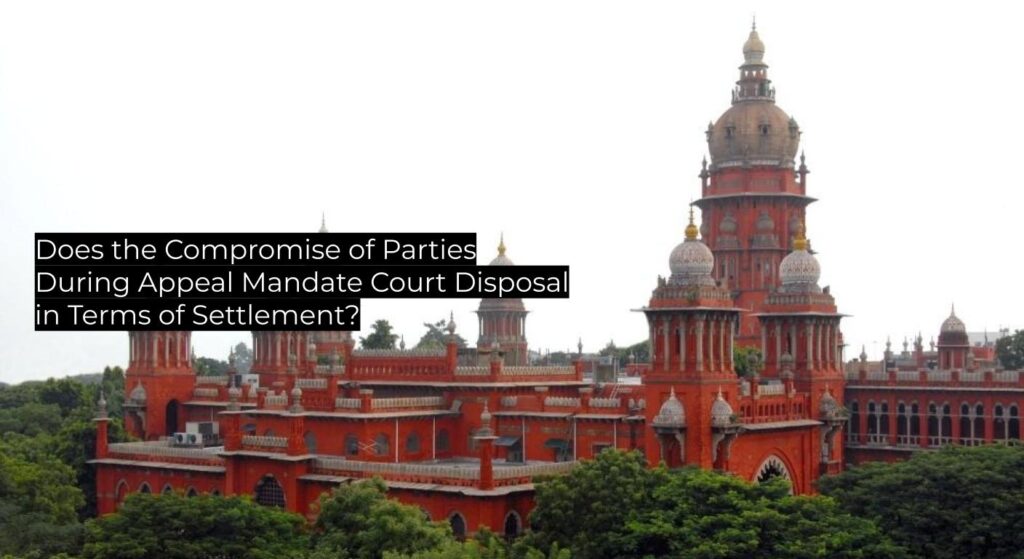
Madras High Court Reaffirms Disposal of Civil Appeals on Memorandum of Understanding; Confirms Binding Precedent for Subordinate Courts
Summary
| Category | Data |
|---|---|
| Case Name | AS/462/2021 of M.JAYACHANDRAN(DIED) Vs C. TAMILARASI |
| CNR | HCMA010770142021 |
| Date of Registration | 24-11-2021 |
| Decision Date | 15-10-2025 |
| Disposal Nature | DISPOSED OF IN MEMO OF COMPROMISE |
| Judgment Author | HONOURABLE DR.JUSTICE A.D.MARIA CLETE |
| Court | Madras High Court |
| Precedent Value | Binding on subordinate courts |
| Type of Law | Civil Procedure |
| Questions of Law | Whether an appeal filed under Section 96 read with Order 41 Rule 1 CPC may be disposed of in terms of a Memorandum of Understanding executed by all parties and presented during the pendency of the appeal. |
| Ratio Decidendi |
Where all parties to a civil appeal file a Memorandum of Understanding duly signed by them and their counsel, and confirm comprehension and voluntary consent to the terms, the court may dispose of the appeal in accordance with the compromise. The terms of such a compromise will form part of the decree. No adjudication on merits is necessary where mutual settlement occurs, and the resultant order reflects the parties’ consent. Court costs may be independently ordered. |
| Facts as Summarised by the Court |
The appeal arose from a judgment and decree of the III Additional District and Sessions Court, Coimbatore, in OS.No.881 of 2007. During the pendency of the appeal, the parties and their counsel presented a Memorandum of Understanding dated 13.09.2025, confirming a compromise. The MoU was explained, and all parties acknowledged voluntary comprehension of the terms. The court disposed of the appeal suit based on this compromise. |
Practical Impact
| Category | Impact |
|---|---|
| Binding On | All subordinate courts |
| Persuasive For | Other High Courts, to the extent not inconsistent with their procedure |
What’s New / What Lawyers Should Note
- Reaffirms that civil appeals under Section 96 CPC, read with Order 41 Rule 1, may be disposed of on terms mutually agreed by all parties via a recorded Memorandum of Understanding.
- Ensures that such compromise, when voluntarily entered and acknowledged in open court, will form part of the decree without requiring adjudication on merits.
- Lawyers should ensure that Memoranda of Compromise are explicit and properly signed by all parties and their counsel for smooth court acceptance.
Summary of Legal Reasoning
- The court noted that both appellants and respondents, along with their counsel, were present and had executed a Memorandum of Understanding (MoU) dated 13.09.2025.
- The contents of the MoU were explained to the parties, and their understanding and acceptance of its terms were confirmed.
- In light of the voluntary and informed compromise, the court concluded that the appeal suit should be disposed of in accordance with the MoU.
- The order specified that the MoU would form part of the decree, aligning with established civil procedure. No order as to costs was made, and the connected miscellaneous petition was closed.
Arguments by the Parties
Appellants:
- Appeared in person with counsel and agreed to the terms of the compromise as set out in the Memorandum of Understanding.
Respondents:
- Appeared (some through counsel, some in person), confirmed understanding and voluntary acceptance of the compromise terms in the Memorandum of Understanding.
Factual Background
The litigation originated from a suit (OS.No.881 of 2007) on the file of the III Additional District and Sessions Court, Coimbatore. Following adverse judgment and decree, the appellants filed an appeal under Section 96 read with Order 41 Rule 1 CPC. During the pendency of the appeal, all parties mutually resolved their differences and formalised their settlement in a Memorandum of Understanding dated 13.09.2025, presented and affirmed before the Madras High Court.
Statutory Analysis
The judgment records application of Section 96 CPC (governing appeals from original decrees) and Order 41 Rule 1 (procedure for filing appeals). The disposal was effected in accordance with the compromise provisions of the CPC, permitting a suit/appeal to be decreed in terms of a compromise when all parties voluntarily agree, duly recorded by the court. Section 151 CPC (inherent power) was also invoked for stay petition. There is no indication of interpretation or expansion of statutory provisions beyond established procedure.
Alert Indicators
- Precedent Followed – The judgment reaffirms the established practice under the CPC for disposal of civil appeals on the basis of a compromise, without departing from precedent.