


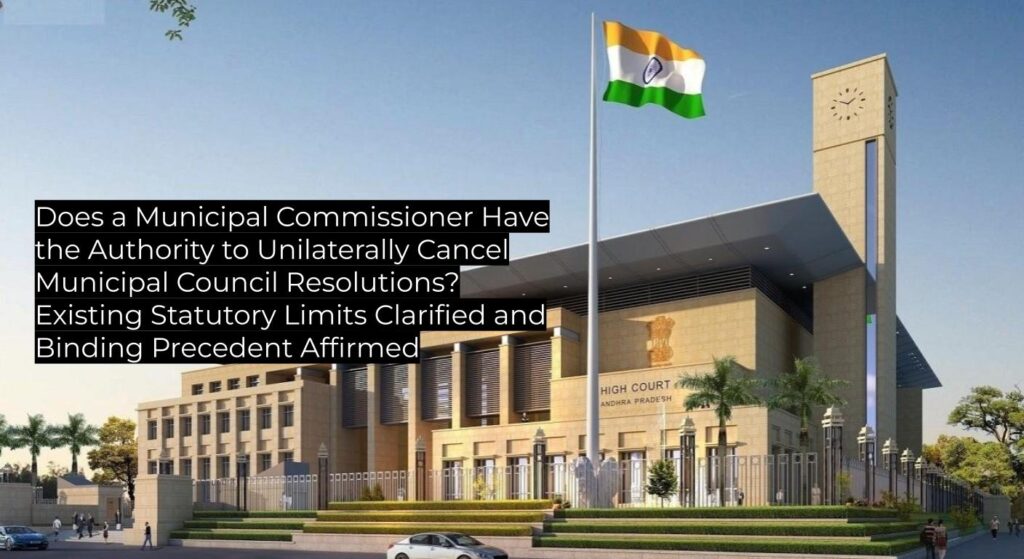
The Andhra Pradesh High Court reaffirms that a Municipal Commissioner lacks power to set aside council resolutions—such authority lies solely with the Government under Section 679-A of the Greater Hyderabad Municipal Corporation Act, 1955. The decision upholds established law and serves as binding precedent for future municipal governance matters.
Summary
| Category | Data |
|---|---|
| Case Name | WA/1083/2025 of Smt. Reddappagari Madhavi Reddy, Vs K. Suresh Babu |
| CNR | APHC010513042025 |
| Date of Registration | 08-10-2025 |
| Decision Date | 15-10-2025 |
| Disposal Nature | DISMISSED NO COSTS |
| Judgment Author | DHIRAJ SINGH THAKUR, R. RAGHUNANDAN RAO |
| Court | High Court of Andhra Pradesh |
| Bench | DHIRAJ SINGH THAKUR, CJ; R. RAGHUNANDAN RAO, J |
| Precedent Value | Binding on subordinate courts in Andhra Pradesh |
| Overrules / Affirms | Affirms the single judge decision |
| Type of Law | Municipal/Administrative Law |
| Questions of Law |
|
| Ratio Decidendi |
The Court held that the Commissioner does not have the power to cancel or set aside resolutions passed by the Municipal Council. Such power resides exclusively with the Government under Section 679-A of the Act, which may act suo moto or on representation from the Commissioner, Mayor, or Councilors. The Court also reasoned that where Government does not exercise its powers within a reasonable time, Council decisions should not be left unresolved, and implementation is warranted. Thus, the directions for implementation of the Council’s resolution, in absence of Government intervention, are valid. |
| Logic / Jurisprudence / Authorities Relied Upon by the Court | Interpretation of Sections 88(h) and 679-A, Greater Hyderabad Municipal Corporation Act, 1955; statutory scheme of delegation and oversight. |
| Facts as Summarised by the Court | The Commissioner set aside a Municipal Council resolution alleging procedural irregularities, including inadequate notice, improper venue, lack of quorum, and faulty record-keeping. The appellant challenged this action and the single judge ruled the Commissioner exceeded his authority, as only the Government holds such power under the statute. The appellant admitted to the statutory limitation on the Commissioner’s power. |
Practical Impact
| Category | Impact |
|---|---|
| Binding On | All subordinate courts in Andhra Pradesh and municipal authorities governed by the Greater Hyderabad Municipal Corporation Act, 1955 |
| Persuasive For | Courts in other states dealing with similar municipal statutory frameworks |
| Follows | The statutory scheme of the Greater Hyderabad Municipal Corporation Act, 1955; interpretation by single judge in W.P.No.18445 of 2025 |
What’s New / What Lawyers Should Note
- Clarifies and affirms that the Municipal Commissioner has no authority to unilaterally cancel or suspend council resolutions; this power lies exclusively with the Government under Section 679-A of the Act.
- The absence of Government action within a reasonable period post-resolution supports immediate implementation of council decisions.
- Delays by the Government cannot be used to leave council resolutions in abeyance; judicial directions for implementation in such cases are proper.
Summary of Legal Reasoning
- The Court examined whether the Commissioner had legal authority to annul a resolution passed by the Municipal Council, referencing Section 679-A of the Greater Hyderabad Municipal Corporation Act, 1955.
- The appellant’s counsel conceded that the statute does not empower the Commissioner to cancel or set aside council resolutions, acknowledging this function is reserved for the Government either suo moto or on representation.
- The Court accepted that only the Government has the power to interfere with or annul a council resolution, following the plain statutory language.
- Considering the Government did not exercise its power under Section 679-A for a substantial duration and no fresh representation was made, the Court held that leaving the council’s decision unresolved was unjustified.
- The direction of the single judge to implement the council’s resolution was therefore found proper and legally justified.
Arguments by the Parties
Petitioner (Appellant):
- Contended that the second part of the single judge’s order, directing implementation of the resolution, would take away the Government’s power under Section 679-A of the Act.
- Initially challenged the Commissioner’s overall authority but later conceded that the Commissioner lacked the statutory power to set aside council resolutions.
Respondent:
- Argued that since the Government had not exercised its power to annul or suspend the council’s resolution and no formal representation had been made, the council’s decision should not linger unresolved.
- Supported the single judge’s directive for implementation of the resolution.
Factual Background
The dispute arose after the Commissioner of Kadapa Municipal Corporation set aside a council resolution dated 20.06.2025, citing non-compliance with notice requirements, improper venue, lack of quorum, and faulty record-keeping. The appellant challenged this action, leading to a single judge’s ruling that such power is statutorily reserved for the Government. On appeal, the appellant conceded the statutory limitation, focusing the dispute on whether the resolution should be directed to implementation in the absence of Government action.
Statutory Analysis
The Court analyzed Sections 88(h) and 679-A of the Greater Hyderabad Municipal Corporation Act, 1955. Section 679-A expressly confers on the Government—but not the Commissioner—the authority to cancel or suspend resolutions of the Municipal Council, either suo moto or on representation from specified officers or councilors. The Court gave a plain reading to these sections and did not read additional powers into the text.
Dissenting / Concurring Opinion Summary
No dissenting or separate concurring opinions are recorded in the judgment.
Procedural Innovations
No new procedural innovations or changes to standard litigation practice were introduced in this judgment.
Alert Indicators
- ✔ Precedent Followed – The ruling affirms the statutory framework and earlier single judge decision; no new law is created and no past precedent is overruled.