


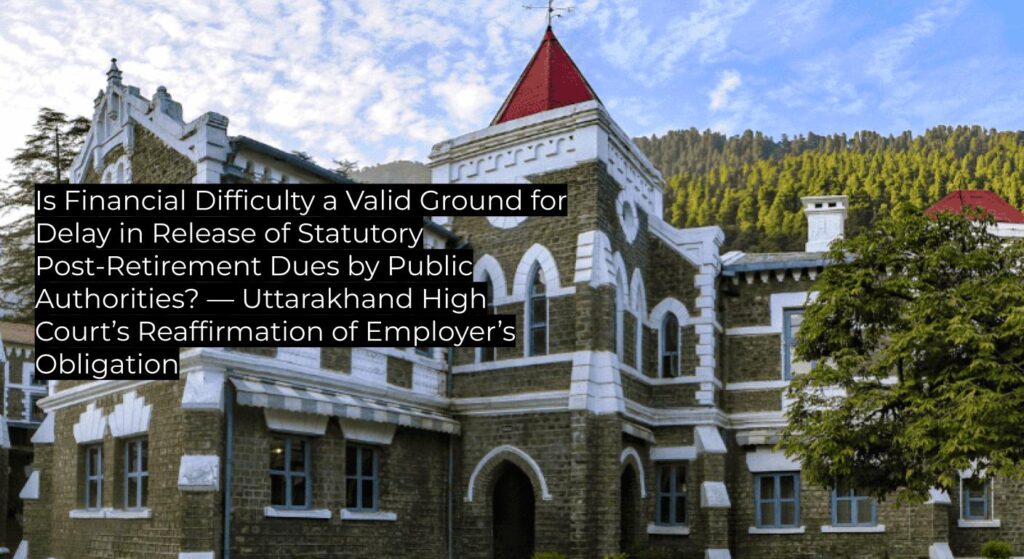
Uttarakhand High Court mandates timely release of admitted post-retirement benefits despite financial crunch, upholding settled law; reinforces binding obligation of public employers in service law matters—binding precedent within Uttarakhand.
Summary
| Category | Data |
|---|---|
| Case Name | WPSS/1638/2025 of DARMIYAN SINGH Vs STATE OF UTTARAKHAND |
| CNR | UKHC010155652025 |
| Date of Registration | 26-09-2025 |
| Decision Date | 17-10-2025 |
| Disposal Nature | DISPOSED |
| Judgment Author | HON’BLE MR. JUSTICE MANOJ KUMAR TIWARI |
| Court | High Court of Uttarakhand |
| Precedent Value | Binding on subordinate courts in Uttarakhand |
| Type of Law | Service Law (Employment / Retirement Benefits) |
| Questions of Law | Whether financial hardship exempts public authorities from timely payment of statutory post-retirement benefits (leave encashment) to retired employees. |
| Ratio Decidendi |
The High Court directed Uttarakhand Payjal Nigam to release all admitted dues to the petitioner within four months from the date of production of a certified copy of the order. The employer’s claim of financial crunch was not accepted as a justification for delay. The court reaffirmed that timely payment of post-retirement benefits is a legal obligation and not contingent upon the employer’s financial position. The matter was disposed of on the employer’s assurance that dues would be cleared in the stipulated time. |
| Facts as Summarised by the Court |
The petitioner, a retired Pump Operator from Uttarakhand Payjal Nigam, sought a mandamus for release of ₹6,61,500/- as leave encashment. The employer cited financial crunch for delayed payment but assured that dues would be cleared within four months. The court disposed of the petition, directing release of all admitted dues within that period. |
Practical Impact
| Category | Impact |
|---|---|
| Binding On | All subordinate courts in Uttarakhand; Uttarakhand Payjal Nigam and similar public sector employers within jurisdiction |
| Persuasive For | Other High Courts and authorities in India considering service law issues around post-retirement benefits |
What’s New / What Lawyers Should Note
- The High Court reaffirmed that financial constraints do not excuse delay in the disbursement of post-retirement statutory dues by government authorities.
- A formal judicial direction for time-bound payment (within four months) provides clear recourse for retirees facing similar delays.
- Employers’ undertakings to pay within a court-fixed timeline are accepted but do not dilute the statutory obligation for timely payment.
- This order is binding precedent for all similar service matters arising within Uttarakhand.
Summary of Legal Reasoning
- The court considered the admitted position that dues were not released on time and the only justification offered was “financial crunch.”
- The standing legal position is that post-retirement benefits, such as leave encashment, are statutory and non-payment or delayed payment cannot be excused on grounds of budgetary issues or employer hardship.
- The assurance given by counsel for the employer (Uttarakhand Payjal Nigam) to release the entire amount within four months was taken on record.
- Mandamus issued directing employer to comply within the specified period, ensuring enforceable redressal for the retiree.
Arguments by the Parties
Petitioner:
- Sought mandamus for release of ₹6,61,500/- towards leave encashment.
Respondent (Uttarakhand Payjal Nigam):
- Admitted dues.
- Cited financial crunch as the reason for delay.
- Assured the court of payment of all pending dues within four months.
Respondent (State):
- No independent arguments detailed in the judgment.
Factual Background
The petitioner retired as a Pump Operator from Uttarakhand Payjal Nigam on 31.3.2025. He approached the High Court seeking a mandamus for the release of ₹6,61,500/- as leave encashment, which had not been paid post-retirement. The employer cited financial difficulties as the reason for the delay but assured that the dues would be cleared within four months. The court issued direction for time-bound payment.
Statutory Analysis
- The judicial direction relates to statutory post-retirement benefits (specifically, leave encashment), which public sector employers are legally obligated to pay.
- The judgment reaffirms non-acceptance of financial hardship as a statutory defence for delayed payments.
- No specific statutory provision (such as CCS Rules or Payment of Gratuity Act) is cited or analyzed in the judgment.
Dissenting / Concurring Opinion Summary
No dissenting or concurring opinions are recorded in the judgment.
Procedural Innovations
- The order models summary disposal of similar writ petitions through assurance of time-bound payment upon employer admission—establishing efficient relief where facts are undisputed.
Alert Indicators
- ✔ Precedent Followed – The order is consistent with established law requiring prompt payment of post-retirement dues and does not create new law or overrule prior cases.