


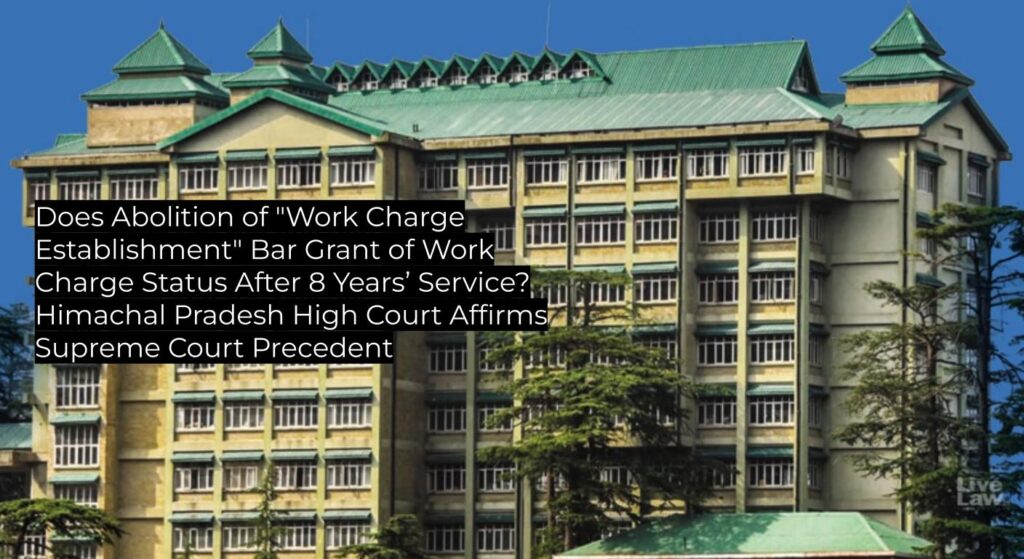
The High Court of Himachal Pradesh has reaffirmed that abolition of the work charge establishment does not preclude eligible employees from claiming work charge status upon completion of eight years’ service, following the Supreme Court’s judgments in Surajmani and Nanak Chand. The decision upholds existing precedent and is binding authority for similar employment matters involving the Himachal Pradesh State Electricity Board and related establishments.
Summary
| Category | Data |
|---|---|
| Case Name | CWP/16432/2025 of VIJAY RAM Vs THE HPSEBL AND OTHERS |
| CNR | HPHC010626652025 |
| Date of Registration | 16-10-2025 |
| Decision Date | 17-10-2025 |
| Disposal Nature | Disposed Off |
| Judgment Author | HON’BLE MS. JUSTICE JYOTSNA REWAL DUA |
| Court | High Court of Himachal Pradesh |
| Bench | Single Judge Bench: Honourable Ms. Justice Jyotsna Rewal Dua |
| Precedent Value | Binding authority for subordinate courts and employment matters within Himachal Pradesh |
| Overrules / Affirms | Affirms Supreme Court decisions in Surajmani and Nanak Chand |
| Type of Law | Service Law / Employment Law |
| Questions of Law | Whether abolition of “work charge establishment” by the HP State Electricity Board bars grant of work charge status after eight years’ service as per Supreme Court directions? |
| Ratio Decidendi |
The High Court held that abolition of the work charge establishment by the HPSEBL does not prevent eligible employees from being granted work charge status after 8 years of service. It followed the Supreme Court’s explicit direction that the Surajmani judgment applies mutatis mutandis to the HPSEBL, notwithstanding the Board’s policy changes. Eligible employees are entitled to notional benefits in accordance with prior Supreme Court cases. The Court directed that petitioners’ claims be considered in line with the directions in Nanak Chand and Surajmani. |
| Judgments Relied Upon |
|
| Logic / Jurisprudence / Authorities Relied Upon by the Court | The Court relied upon Supreme Court’s direct application of Surajmani’s principles to the context of HPSEBL, holding that administrative abolition does not impair accrued rights under established precedent. Implementation is to be in rem and future appointments must follow lawful procedures as stated in Uma Devi. |
| Facts as Summarised by the Court | Petitioners sought grant of work charge status after completing 8 years’ service, a relief previously declined by the respondent Board on the ground that work charge establishment had been abolished. Counsel for petitioners argued that their cases are covered by the Supreme Court’s decision in Nanak Chand, which applied Surajmani’s directive to HPSEBL. |
Practical Impact
| Category | Impact |
|---|---|
| Binding On | All subordinate courts and authorities in Himachal Pradesh dealing with similar employment claims |
| Persuasive For | Other High Courts and quasi-judicial bodies in India interpreting work charge/employment law |
| Follows |
|
What’s New / What Lawyers Should Note
- Reaffirms that administrative abolition of the work charge establishment does not detract from employee rights to claim work charge status after eight years, when so directed by Supreme Court precedent.
- Petitioners may secure only notional benefits (not actual back wages), as clarified in prior Supreme Court decisions.
- The relief granted is in rem; similarly situated persons may rely on this judgment without filing fresh litigation.
- Respondent authorities must process eligible claims in accordance with the Supreme Court’s latest clarifications and cannot routinely deny relief citing internal policy changes post-1986.
Summary of Legal Reasoning
- The Court began by noting the identical relief sought by all petitioners: grant of work charge status after completion of eight years’ service.
- The petitioners relied on the Supreme Court’s decision in Nanak Chand, which specifically addressed and rejected the HPSEBL’s contention that abolition of the work charge establishment in 1986 distinguished its position from that in Surajmani.
- The Supreme Court in Nanak Chand held that Surajmani’s directions applied mutatis mutandis to HPSEBL, and that administrative arguments regarding abolishing work charge posts did not extinguish employees’ accrued rights.
- The operative portion of Surajmani, as reiterated, mandates grant of work charge status from the date of completion of eight years of service with only notional benefits, not actual financial benefits, unless so specified.
- Additional directions reiterate that implementation is to be in rem with prospective effect that future appointments must be conducted legally, as per Uma Devi.
- The High Court disposed of the petitions by requiring HPSEBL to consider the claims in accordance with the above Supreme Court directions.
Arguments by the Parties
Petitioners:
- Sought direction to grant work charge status upon completion of eight years’ service, relying on the Supreme Court’s Nanak Chand and Surajmani judgments.
- Submitted that abolition of work charge establishment in 1986 does not disentitle them from relief per the Supreme Court’s precedent.
Respondent (HPSEBL):
- Had previously contended (as noted in Nanak Chand and summarized by the Court) that the abolition of the work charge establishment prevents application of Surajmani’s ratio.
- No additional arguments stated in this particular order, but the Board’s earlier objections were directly addressed by the Supreme Court and cited by the petitioners.
Factual Background
The petitioners were employees of the Himachal Pradesh State Electricity Board who had each completed more than eight years of service. They applied for grant of work charge status, which confers specific employment benefits. The Board had declined or failed to grant such status on the ground that the “work charge establishment” was abolished in 1986. The petitioners approached the High Court for relief, contending the matter was already settled by the Supreme Court in the context of HPSEBL in Nanak Chand, which applied Surajmani. The petitions were all listed together due to the identical nature of relief sought.
Statutory Analysis
- The Court discussed the Standing Orders of the Himachal Pradesh State Electricity Board Industrial Establishment (framed under the Factories Act, 1948), focusing on Clause 5(b) that categorizes workmen including those in work charge establishment.
- The Supreme Court, as cited by the High Court, found that these Standing Orders and prior policy revisions did not nullify the right to work charge status accrued under service law principles as interpreted in Surajmani and related precedents.
- No new statutes were interpreted or “read down”; the Court applied existing settled law.
Dissenting / Concurring Opinion Summary
No dissenting or concurring opinions recorded; the order is unanimous and authored solely by Honourable Ms. Justice Jyotsna Rewal Dua.
Procedural Innovations
No new procedural directions, innovations, or guidelines were set out in this judgment. The Court followed established procedure and disposed of the writ petitions on the basis of binding Supreme Court precedent.
Alert Indicators
- ✔ Precedent Followed – When existing law is affirmed.