


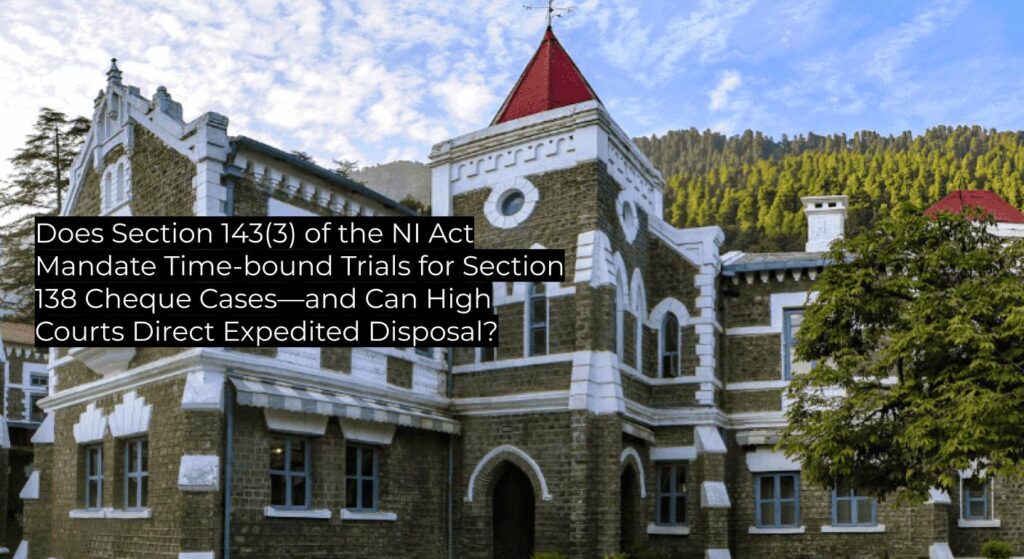
The Uttarakhand High Court has reaffirmed the legislative mandate of Section 143(3) of the Negotiable Instruments Act, requiring expeditious trial in cheque bounce cases under Section 138, and directed subordinate courts to conclude long-pending matters within a prescribed outer limit. This order upholds statutory precedent, reinforces speedy justice in commercial disputes, and is binding on all subordinate courts within Uttarakhand.
Summary
| Category | Data |
|---|---|
| Case Name | C528/1884/2025 of ANIL PAL Vs RUPALI GUPTA |
| CNR | UKHC010166162025 |
| Date of Registration | 15-10-2025 |
| Decision Date | 17-10-2025 |
| Disposal Nature | DISPOSED |
| Judgment Author | HON’BLE MR. JUSTICE PANKAJ PUROHIT |
| Court | High Court of Uttarakhand |
| Bench | Single Bench (Justice Pankaj Purohit) |
| Precedent Value | Binding authority for subordinate courts in Uttarakhand |
| Overrules / Affirms | Affirms statutory mandate of Section 143(3) of the NI Act |
| Type of Law | Criminal Procedure / Negotiable Instruments Act (Section 138 & 143(3)) |
| Questions of Law |
|
| Ratio Decidendi |
The judgment holds that Section 143(3) of the NI Act imposes an obligation to conclude trials under Section 138 as expeditiously as possible, with an endeavour to do so within six months from the complaint. Significant delays, evidenced by cases pending for over six years, contravene this mandate. The court directed subordinate courts to dispose of such cases within one year from the date of order production to ensure the legislative intent of speedy justice under the NI Act is not frustrated. |
| Facts as Summarised by the Court | Multiple criminal complaints under Section 138 NI Act have been pending disposal since as far back as 2019. The applications prayed for directions to expedite proceedings citing statutory mandate. |
Practical Impact
| Category | Impact |
|---|---|
| Binding On | All subordinate courts in Uttarakhand |
| Persuasive For | Other High Courts in India and may have persuasive value elsewhere in cheque bounce matters |
| Follows | Mandate in Section 143(3) of the Negotiable Instruments Act, 1881 |
What’s New / What Lawyers Should Note
- The High Court issued express directions to specific subordinate courts to conclude long-pending Section 138 NI Act cases within one year of production of the order.
- The court reaffirmed that trials under Section 138 NI Act should be completed “as expeditiously as possible” and ideally within six months, as per statutory mandate.
- Lawyers handling cheque bounce cases in Uttarakhand may move the High Court for such directions in case of inordinate delay in trial courts.
- This decision strengthens and operationalizes the legislative intent behind Section 143(3), giving practitioners a clear mechanism to combat delays.
Summary of Legal Reasoning
- The court noted that all applications were filed with the common prayer for directing the subordinate court(s) to expedite proceedings in pending Section 138 NI Act complaints.
- Section 143(3) of the NI Act was specifically cited, which mandates expeditious trial and an endeavour to conclude within six months of complaint filing.
- The court observed that in several cases, more than six years had elapsed without adjudication, which was contrary to the statutory mandate.
- Consequently, the court held that to safeguard the legislative intent, it must direct the courts below to expedite the proceedings and set an outer limit of one year for conclusion from the production of the order.
- The judgment is rooted firmly in giving effect to the plain meaning of Section 143(3).
Arguments by the Parties
Applicants
- Referred to Section 143(3) of the Negotiable Instruments Act, arguing that it mandates expeditious disposal of Section 138 complaints.
- Highlighted that several cases have been pending since 2019, far exceeding the prescribed time limits.
- Prayed for specific directions to expedite the proceedings before the trial court.
Respondents
No arguments by respondents are recorded in the judgment.
Factual Background
Multiple C528 applications were filed before the Uttarakhand High Court by applicants whose complaints under Section 138 of the Negotiable Instruments Act had been pending for several years, some since 2019, before various Judicial Magistrates in Dehradun district. The applications specifically sought directions to the lower courts to expedite adjudication, citing the statutory requirements for speedy trial under Section 143(3) of the NI Act.
Statutory Analysis
- Section 143(3) of the Negotiable Instruments Act, 1881, was interpreted, which provides that every trial under Section 138 shall be conducted as expeditiously as possible, and an endeavour shall be made to conclude the trial within six months from the date of the complaint.
- The judgment applies the provision strictly and operationalizes it by setting an outer time limit for conclusion in delayed cases.
Procedural Innovations
- The High Court consolidated multiple applications raising similar issues and disposed of them by a common judgment.
- The judgment sets an explicit outer time limit (one year) for the trial courts to conclude proceedings after receipt of the order, providing a practical mechanism to enforce statutory directives on expeditious trial.
Alert Indicators
- ✔ Precedent Followed – The judgment affirms and operationalizes the existing statutory mandate in Section 143(3) of the NI Act concerning expeditious trial in cheque bounce cases.