


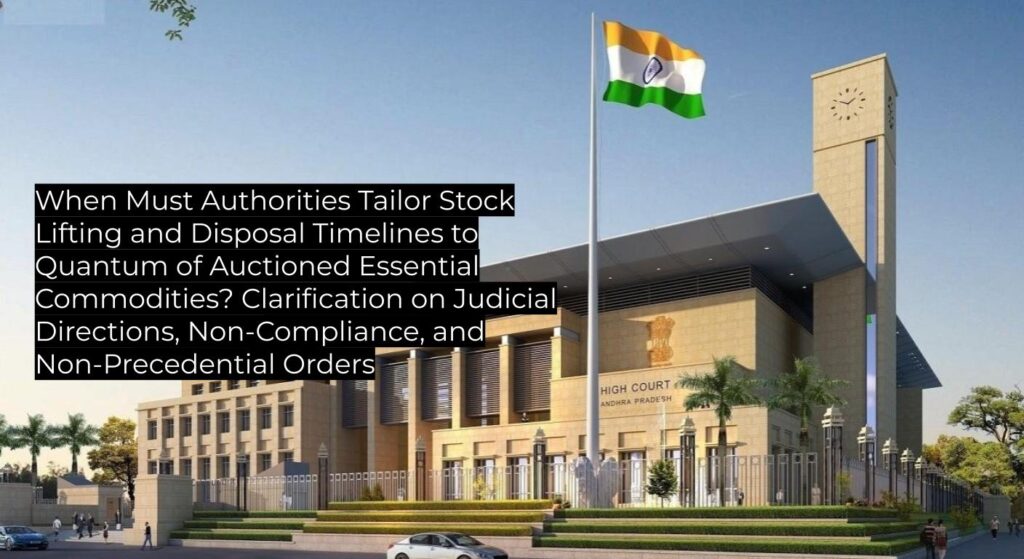
The Andhra Pradesh High Court has clarified that authorities imposing rigid timeframes for lifting and disposing auctioned essential commodities must account for the quantity involved and prior Court directions—even when interim judicial orders exist. However, this specific decision is held not to constitute binding precedent and is confined strictly to the facts of the present case.
Summary
| Category | Data |
|---|---|
| Case Name | WP/13579/2025 of M/S SRI ANNAPURNA MODERN RICE MILL Vs THE STATE OF AP (Common order with WP/29241/2024 and referencing WP/17480/2023) |
| CNR | APHC010341972023 |
| Date of Registration | (Not specified for 2025 petition; referenced registration for WP/17480/2023 is 14-07-2023) |
| Decision Date | 17-10-2025 |
| Disposal Nature | ALLOWED NO COSTS |
| Judgment Author | V. SUJATHA, J. |
| Court | High Court of Andhra Pradesh |
| Bench | Single Judge: Hon’ble Smt. Justice V. Sujatha |
| Precedent Value | Not a binding precedent; explicitly limited to facts of present case |
| Type of Law | Administrative Law, Essential Commodities Act, Natural Justice, Constitutional law (Article 19(1)(g)) |
| Questions of Law |
|
| Ratio Decidendi |
|
| Judgments Relied Upon | WP/17480/2023 of Sri Lakshmi Subbaraya Modern Rice Mill v. State of AP (order dated 21.09.2023) |
| Logic / Jurisprudence / Authorities Relied Upon by the Court |
|
| Facts as Summarised by the Court | After succeeding as auction bidder for PDS rice stocks, the petitioner was subject to authority-imposed rigid deadlines (10 days for lifting, 20 for disposal), which were suspended/interpreted flexibly by interim High Court orders. The authorities failed to revise timelines as directed by the Court, and later confiscated goods and imposed fines, acting without reference to court-ordered discretion or changing market/export conditions. The petitioner continued to attempt disposal and lifting over many months, with facts not seriously disputed between the parties. |
Practical Impact
| Category | Impact |
|---|---|
| Binding On | Not binding; order expressly declared not to be precedent, applicable only to present facts. |
| Persuasive For | None (Court expressly restricts citation or reliance in future matters). |
| Follows | Order in WP/17480/2023 (AP High Court directions on tailored timeline for auction stock handling). |
What’s New / What Lawyers Should Note
- The Court reiterates that directions regarding timelines for lifting and disposal of auctioned stocks must account for quantity, not be arbitrary or uniform.
- Orders that departure from court-directed exercise of discretion, or imposition of rigid schedules contrary to judicial instruction, will invalidate subsequent confiscatory actions.
- Explicitly limits the order’s precedential value—cannot be cited in unrelated or future cases.
- Even where alternative statutory remedy exists (Section 6C, EC Act), the High Court may intervene in cases of clear non-compliance with its earlier specific directions.
- Lawyers should not treat this ruling as laying down general law but as relief confined strictly to the facts at hand and judicial non-compliance.
Summary of Legal Reasoning
- The High Court had earlier directed, in WP/17480/2023, that timeframes for stock lifting/disposal should vary in proportion to the quantum of the commodity involved.
- The respondent authorities ignored this direction and issued schedules with the same rigid deadlines as before, without considering the quantum.
- The seizure of petitioner’s stock and vehicle, and consequent confiscatory proceedings, were carried out without respecting prior interim and final orders of the Court, and without fair opportunity or reasonable accommodation for practical difficulties (such as export bans or stock availability).
- The rationale of justice and natural justice requires authorities to exercise discretion in good faith and to comply with Court directions, especially where deprivation of property and livelihood are involved.
- The Court observed that the authorities’ failure to comply with its own directions led to the technical breach, for which the petitioner could not be penalized.
- The final order sets aside the confiscation and fine, with tailored directions for expeditious release and disposal under Court supervision.
- However, the Court expressly circumscribes its order, stating it is not a precedent owing to the peculiar facts.
Arguments by the Parties
Petitioner:
- The authorities’ imposition of rigid deadlines for lifting and disposing stock was not only unsupported by law but also in disregard of High Court directions to tailor schedules based on quantum.
- Stock could not be disposed expeditiously due to an intervening ban on rice exports, significantly reducing domestic demand and prices.
- The authorities failed to make the entire stock available for lifting promptly; the minimal remaining stock further reduced the scope for violation.
- Seizure and confiscation actions did not consider either judicial directions or actual compliance efforts made by the petitioner.
- Sought expeditious release so as to complete disposal within a practical and reasonable timeframe.
Respondent (State/Civil Supplies):
- Asserted that the petitioner, having purchased auctioned stock at concessional rates, was bound by notified schedules, and delay resulted in stock holding beyond legal timeframe.
- The authorities permitted lifting and disposal over a prolonged period, but the petitioner failed to complete the process as required.
- Invoked Section 6A of the Essential Commodities Act and departmental circulars as binding, justifying seizure/confiscation.
- Contended the petitioner’s failure to use the alternate statutory remedy (appeal to District Judge under Section 6C) before invoking High Court jurisdiction.
Factual Background
The dispute arose from the petitioner company’s successful bid in an official open auction for confiscated Public Distribution System (PDS) rice. The auction required prompt lifting (within 10 days) and disposal (within 20 days) of stocks—a condition the High Court later suspended and directed to be reframed based on the scale of stocks involved. The authorities failed to revise their schedule as directed, but meanwhile permitted piecemeal lifting and disposal for nearly a year. Amid a nationwide ban on rice export, the petitioner’s sale capacity was hampered. When 260 quintals of rice were being transported for sale, the authorities seized both the vehicle and stock, later passing an order of complete confiscation with penalty. All actions were challenged by the petitioner in successive writ petitions.
Statutory Analysis
- Essential Commodities Act, 1955, Section 6A: Provides for confiscation of goods seized in contravention of the Act.
- Section 6C: Provides for appeal to District and Sessions Judge against confiscation orders.
- The Court interpreted that the use and enforcement of schedules/timeframes for handling auctioned stocks must be informed by fairness, be tailored to the quantum of stocks, and comply with specific judicial directions.
- Article 19(1)(g) of the Constitution: Invoked as the petitioner’s right to carry on trade/profession was curtailed by arbitrary and unreasoned action.
Procedural Innovations
- The Court noted and acted despite the existence of a statutory alternative remedy (Section 6C, EC Act), citing egregious non-compliance with its own prior directions as warranting exercise of writ jurisdiction.
Alert Indicators
- ✔ Precedent Followed (to extent of following prior High Court direction regarding tailoring timeframes to quantum of stock). No breaking precedent; however, judgment itself expressly rules out precedential effect for the future.