


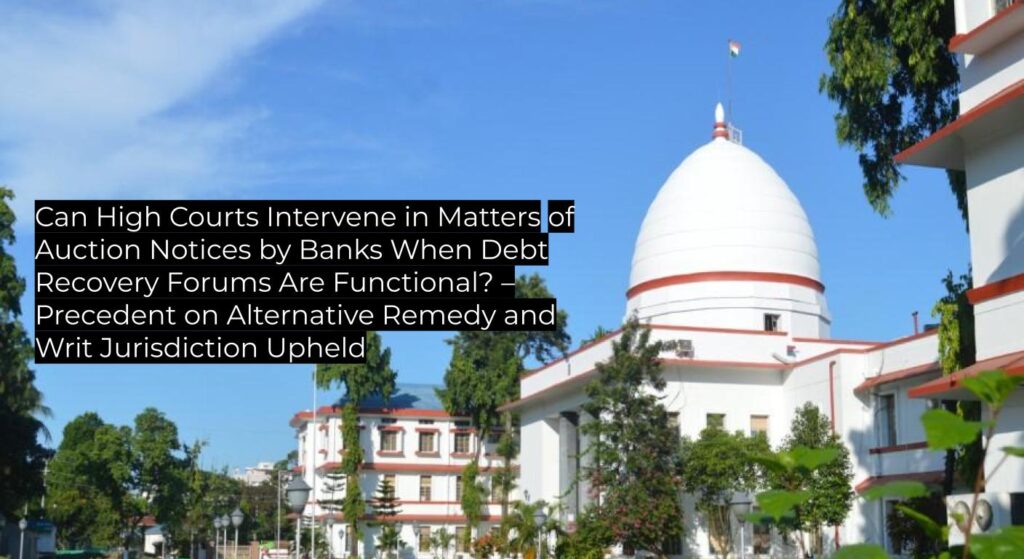
Gauhati High Court reaffirms that High Courts ordinarily will not exercise writ jurisdiction under Article 226 when statutory alternative remedies like Debt Recovery Tribunal (DRT) are available and functional. The judgment upholds established precedent, reinforcing the principle of relegation to statutory forums in banking and debt recovery disputes. Persuasive and binding precedent for such matters within the High Court’s territorial jurisdiction.
Summary
| Category | Data |
|---|---|
| Case Name | WP(C)/5949/2025 of M/S SILVERLINE ENTERPRISE AND ANR Vs BRANCH MANAGER OF BANK OF INDIA, SME BRANCH AND ANR |
| CNR | GAHC010221782025 |
| Date of Registration | 16-10-2025 |
| Decision Date | 17-10-2025 |
| Disposal Nature | Dismissed |
| Judgment Author | Honourable The Chief Justice Mr. Ashutosh Kumar |
| Concurring or Dissenting Judges | Honourable Mr. Justice Arun Dev Choudhury (Concurring) |
| Court | Gauhati High Court |
| Bench | Honourable The Chief Justice Mr. Ashutosh Kumar, Honourable Mr. Justice Arun Dev Choudhury |
| Precedent Value | Binding within Gauhati High Court jurisdiction; persuasive value elsewhere |
| Overrules / Affirms | Affirms existing law requiring exhaustion of alternative remedy before invoking writ jurisdiction |
| Type of Law | Banking Law, Debt Recovery, Writ Jurisdiction |
| Questions of Law | Whether the High Court should entertain a writ petition challenging an auction notice issued by a bank when the Debt Recovery Tribunal is functional and available as remedy |
| Ratio Decidendi |
The High Court found no good ground to exercise writ jurisdiction since the auction notice was issued long ago and the petitioners had an effective alternative remedy before the Debt Recovery Tribunal, which was functional. The judgment reaffirmed that parties are expected to approach the statutory forum (DRT) for relief, rather than invoking the extraordinary jurisdiction of the High Court. Writ jurisdiction is not an alternative to the statutory remedy unless exceptional circumstances exist. The writ was thus dismissed, with liberty to approach DRT if so advised. |
| Facts as Summarised by the Court |
Petitioners challenged an auction notice issued by the Bank of India, SME Branch. The notice was issued a long time ago. No exceptional grounds were cited for bypassing the statutory remedy. The Debt Recovery Tribunal was found to be functional at the time of hearing. Petitioners were advised to approach the DRT if necessary. |
Practical Impact
| Category | Impact |
|---|---|
| Binding On | All subordinate courts within the jurisdiction of the Gauhati High Court |
| Persuasive For | Other High Courts and fora considering the scope of writ jurisdiction in presence of alternative remedies under banking law |
| Follows | Affirms settled law on exhaustion of alternative remedies and the bar on writ petitions where DRT is available |
What’s New / What Lawyers Should Note
- The Gauhati High Court reiterates that writ petitions against auction notices by banks are not maintainable where the Debt Recovery Tribunal is functional.
- Petitioners must approach the statutory forum (DRT); writ remedy is not ordinarily available.
- The decision reinforces the settled hierarchy of remedies in banking and debt recovery matters.
- Said approach upholds judicial discipline and efficient forum management.
- Lawyers should advise clients to approach available statutory forums first.
Summary of Legal Reasoning
- The Court observed that the auction notice was issued a long time before the filing of the writ petition.
- Petitioners failed to show any special circumstances that would justify bypassing the alternative remedy.
- The Debt Recovery Tribunal was confirmed to be functional and available for redressal of grievances.
- The High Court reiterated the principle that writ jurisdiction under Article 226 is not to be exercised when a statutory forum is available, barring exceptional circumstances.
- The petitioners were thus advised to approach the DRT if they considered it necessary.
- The writ petition was dismissed accordingly.
Arguments by the Parties
Petitioner
- Sought to challenge the auction notice issued by the Bank of India.
Respondent
- Submitted that the petitioner has an alternative remedy before the Debt Recovery Tribunal, which is functional.
Factual Background
The petitioners challenged an auction notice issued by the Bank of India, SME Branch. The auction notice had been issued long before the writ petition was filed. The main contention pertained to the maintainability of a writ petition in light of the functioning Debt Recovery Tribunal. The High Court found that no exceptional circumstances were pleaded to justify invoking writ jurisdiction.
Statutory Analysis
The Court analyzed the provisions underlying the jurisdiction of the Debt Recovery Tribunal under applicable banking and debt recovery legislation and the writ jurisdiction of the High Court under Article 226 of the Constitution of India. The analysis emphasized the established rule that the High Court ordinarily does not exercise writ jurisdiction when effective alternative remedies are available under statute, unless exceptional circumstances exist.
Dissenting / Concurring Opinion Summary
No dissenting or separate concurring opinions are recorded; both judges agreed with the decision and reasoning.
Procedural Innovations
No new procedural precedents or innovations are indicated in the judgment.
Alert Indicators
- ✔ Precedent Followed – The judgment affirms the established principle regarding exhaustion of alternative remedies and the bar on writ jurisdiction when DRT is functional.