


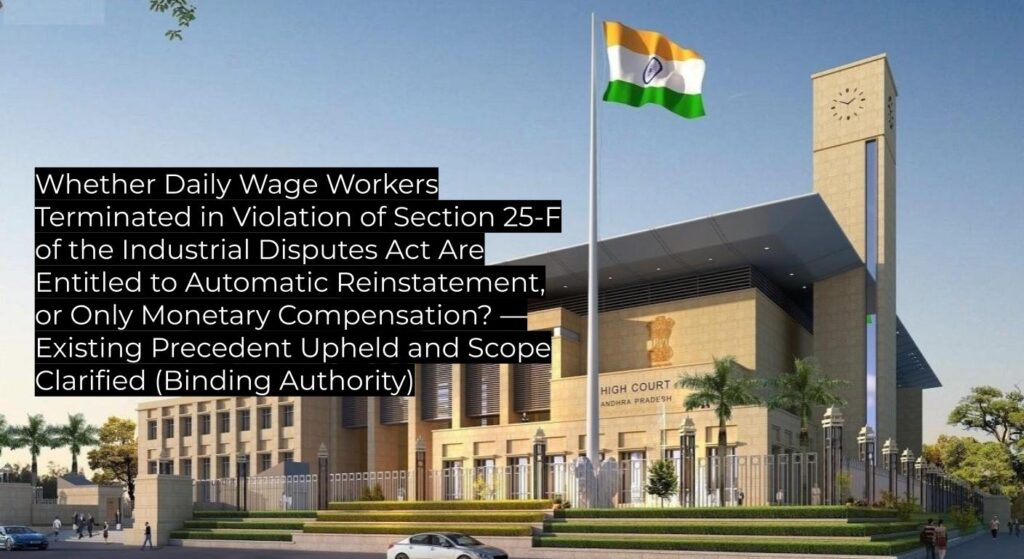
The Andhra Pradesh High Court has reaffirmed that monetary compensation, rather than automatic reinstatement or back wages, is the appropriate remedy for daily wage/NMR workers whose services are terminated in violation of Section 25-F of the Industrial Disputes Act. This ruling upholds Supreme Court precedent, clarifies the limited grounds for High Court interference with Tribunal awards under Article 226, and confirms that financial incapacity of a public sector undertaking does not absolve it from statutory obligations under Article 12. Binding on subordinate courts within Andhra Pradesh, the judgment offers practical guidance for similar future disputes in the industrial sector.
Summary
| Category | Data |
|---|---|
| Case Name | WP/28989/2016 of M/s. Kovur Co-Operative Sugar Factory Ltd., Vs The State of Andhra Pradesh, CNR APHC010324482016 |
| Date of Registration | 27-08-2016 |
| Decision Date | 17-10-2025 |
| Disposal Nature | DISMISSED NO COSTS |
| Judgment Author | Justice Maheswara Rao Kuncheam |
| Court | High Court of Andhra Pradesh |
| Bench | Single Judge — Justice Maheswara Rao Kuncheam |
| Precedent Value | Binding on subordinate courts in Andhra Pradesh; has persuasive authority for other High Courts |
| Overrules / Affirms | Affirms existing Supreme Court and High Court precedent |
| Type of Law | Labour and Service Law — Industrial Disputes Act, Constitutional Law |
| Questions of Law | Whether daily wage/NMR/casual employees, terminated without compliance with Section 25-F of the Industrial Disputes Act, are entitled to reinstatement and back wages, or whether monetary compensation is an adequate remedy. |
| Ratio Decidendi |
The Court held that reinstatement with full back wages is not an automatic consequence for daily wage/casual/NMR workers terminated in violation of Section 25-F of the Industrial Disputes Act. Instead, awarding suitable monetary compensation is appropriate, particularly where there is no evidence of regularization or clear vacancy, and where the employer establishment is non-functional. The judgment also clarified that a public sector undertaking cannot use financial incapacity as a ground to deny lawful compensation, and that the High Court’s writ jurisdiction over Tribunal awards is limited to manifest errors or jurisdictional lapses. The existing legal regime as laid down by the Supreme Court in Bharat Sanchar Nigam Ltd. v. Bhurumal and related line of authorities was affirmed. |
| Judgments Relied Upon |
|
| Logic / Jurisprudence / Authorities Relied Upon by the Court |
The Court drew extensively from Supreme Court jurisprudence holding that when the only illegality in the termination of daily wage/NMR workers is non-compliance with Section 25-F, reinstatement need not follow and compensation suffices. The State/PSU’s financial distress is not a defence to evade statutory/liability obligations under Article 12. The scope of writ interference over Tribunal awards is strictly limited to errors apparent on face of record or jurisdictional usurpation. |
| Facts as Summarised by the Court |
The workman was engaged as NMR Security Guard since 1989. The Sugar Factory terminated the services of 281 NMRs, including the petitioner, w.e.f. 15.04.2005, citing non-functioning and restructuring. The workman challenged termination, first via writ (decided on technical grounds), then by raising an industrial dispute seeking reinstatement and back wages. The Tribunal awarded Rs.50,000 compensation in lieu of reinstatement. Both sides filed writ petitions challenging this award. |
Practical Impact
| Category | Impact |
|---|---|
| Binding On | All subordinate courts within the jurisdiction of the Andhra Pradesh High Court |
| Persuasive For | Other High Courts and potentially before the Supreme Court |
| Overrules | None (Case affirms and applies existing Supreme Court precedent) |
| Distinguishes | Distinguishes between daily wage/NMR/casual workers and regular/permanent employees for purposes of relief |
| Follows |
|
What’s New / What Lawyers Should Note
- The judgment definitively reiterates that for NMR/daily wage/casual workers terminated only on the ground of violation of Section 25-F, monetary compensation, and not reinstatement plus back wages, is ordinarily the appropriate relief.
- The High Court’s supervisory jurisdiction under Article 226 over Industrial Tribunal awards is narrow: reappreciation of evidence or substitution of factual conclusions is not permitted unless there is manifest illegality or jurisdictional error.
- Public sector undertakings and government-controlled corporations cannot avoid their statutory liability to pay compensation on grounds of financial incapacity, being bound by Article 12 of the Constitution.
- The award of Rs. 50,000 as compensation in lieu of reinstatement was held reasonable, given the non-functional status of the employer and lack of proof of regular/vacancy employment.
Summary of Legal Reasoning
- The Court analyzed the evidence, noting the workman’s claim of continuous service as an NMR Security Guard and the employer’s denial of regular employment status.
- The Tribunal did not record any finding that the workman held a permanent position or was appointed against a regular vacancy.
- Relying on Supreme Court precedent—primarily Bharat Sanchar Nigam Ltd. v. Bhurumal, Metropolitan Transport Corporation v. V. Venkatesan, and Coal India Ltd. v. Ananta Saha—the Court observed that for daily wage/NMR/casual workers (not regular employees) terminated in breach of Section 25-F, reinstatement and back wages are not automatic and monetary compensation suffices.
- The judgment emphasized that the writ court’s scope to interfere with Tribunal awards is limited, referencing Shamshad Ahmad v. Tilak Raj Bajaj and Ajay Singh v. Khacheru; interference is warranted only for errors apparent on the face of the record or jurisdictional/procedural violations.
- The argument of financial incapacity by a public sector undertaking was negated, with reliance on constitutional obligations under Article 12 (Kapila Hingorani v. State of Bihar; Haryana State Minor Irrigation Tubewells Corp. v. G.S. Uppal).
- The Court found no jurisdictional or manifest legal error in the Tribunal’s award, and confirmed the amount of Rs. 50,000 to the workman.
Arguments by the Parties
Petitioner
- Claimed continuous service as NMR Security Guard in a regular vacancy since 1989.
- Argued that termination was illegal for non-compliance with Section 25-F of the Industrial Disputes Act.
- Sought reinstatement with full back wages and attendant benefits.
- Contended that the employer’s financial status or non-functioning cannot override statutory obligations.
Respondent
- Asserted that the factory had not been functioning since 2003.
- Denied regular employment status for the workman; stated that he was only a casual worker.
- Raised financial crisis as a defence against liability.
- Submitted, during proceedings, that the jurisdictional point was not pressed.
Factual Background
The workman was employed as an NMR Security Guard at the Sugar Factory since 1989. On 15.04.2005, the services of 281 NMR/casual workers, including the petitioner, were terminated due to non-functioning of the factory and government-led downsizing measures. The workman initially challenged the termination through a writ, which was remanded for industrial adjudication. Before the Industrial Tribunal, the workman sought reinstatement and back wages; the Tribunal instead awarded compensation of Rs. 50,000. Both parties challenged the award in separate writ petitions before the High Court.
Statutory Analysis
- Section 25-F of the Industrial Disputes Act, 1947 was central—requiring retrenchment compensation and notice before termination of service for workmen who have completed requisite service.
- Article 12 of the Constitution of India was invoked to classify the Sugar Factory as “State” for the purposes of public law obligations.
- The Court did not expansively interpret any provision but applied the settled law that violation of Section 25-F, in the case of daily wage/casual workmen, does not automatically result in reinstatement.
- The distinction between permanent and temporary/NMR/daily wage workmen under the ID Act framework was reinforced.
Dissenting / Concurring Opinion Summary
No dissenting or separate concurring opinions — single judge decision.
Procedural Innovations
- No new procedural precedents or innovations were introduced.
- The Court restated the limited writ jurisdiction standard over Industrial Tribunal awards.
Alert Indicators
- ✔ Precedent Followed – When existing law is affirmed.