


Summary
| Category | Data |
|---|---|
| Court | Supreme Court of India |
| Case Number | C.A. No.-001808 – 2020 |
| Diary Number | 7358/2020 |
| Judge Name | HON’BLE THE CHIEF JUSTICE |
| Bench |
|
| Precedent Value | Binding authority on interpretation of Sections 30–31 IBC and role of RfRP in CIRP |
| Overrules / Affirms |
|
| Type of Law | Insolvency & Bankruptcy Code, 2016; IBBI (CIRP) Regulations, 2016 |
| Questions of Law | Whether EBITDA generated during CIRP must be distributed to creditors absent any specific RfRP or resolution-plan provision? |
| Ratio Decidendi |
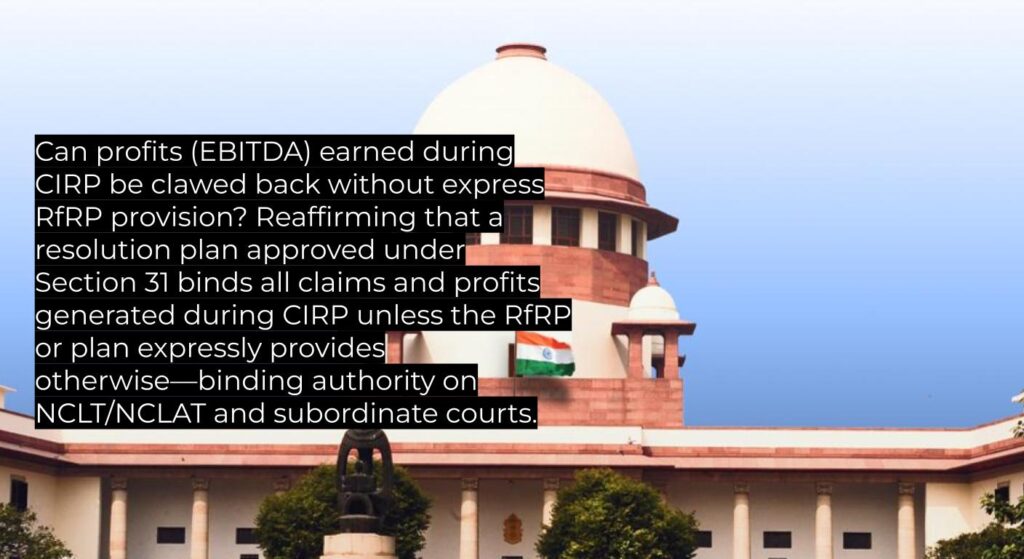
The Supreme Court held that once a resolution plan is approved under Section 31, all claims and profits generated during CIRP stand “frozen” unless the RfRP or the plan expressly provides for their treatment. CoC meetings and monitoring committees continue until implementation or liquidation order. Section 32A immunity and Explanation to Reg 18 IBBI confirm that post-approval pendency of criminal/attachment proceedings may delay but not invalidate plan implementation. The Court reaffirmed the “hydra-head” principle: no new or undecided claims may be sprung on a successful resolution applicant post-approval. |
| Judgments Relied Upon |
|
| Logic / Jurisprudence / Authorities Relied Upon |
|
| Facts as Summarised by the Court |
The RBI identified BPSL as a “dirty dozen” defaulter and PNB initiated CIRP under Section 7. CoC approved JSW’s plan in October 2018; NCLT sanctioned it Sept 2019 subject to EBITDA-sharing and other conditions. CBI/ED launched criminal and PMLA actions, attaching assets. NCLAT modified NCLT order in Feb 2020; this Court set aside both in May 2025, held plan non-compliant with Section 30(2)/31(2), and directed liquidation. Review allowed July 2025; all issues reopened. |
Practical Impact
| Category | Impact |
|---|---|
| Binding On | NCLT, NCLAT, Insolvency Professionals, CoC |
| Persuasive For | Other High Courts, tribunals interpreting Sections 30–31 IBC |
| Overrules | NCLAT Essar (2019 SCC OnLine NCLAT 388) |
| Distinguishes | NCLT Essar approval-order (modified on facts, pre-Supreme Court Essar) |
| Follows | Supreme Court Essar (2019 SCC OnLine SC 1478) |
What’s New / What Lawyers Should Note
- Supreme Court confirms the “hydra-head” principle: no new or undecided claims (including EBITDA) may be sprung post-approval absent express RfRP/plan term.
- Resolution plans approved under Section 31 bind all stakeholders; commercial-wisdom challenges are non-justiciable unless plan contravenes Sections 30(2)/31.
- CoC and monitoring committees retain powers after NCLT approval until plan implementation or liquidation—clarified by Explanation to Regulation 18 IBBI.
- Section 32A IBC immunity and Attachment-proceeding stay do not retroactively invalidate plan; criminal and ED attachments may delay but cannot nullify implementation.
- CCDs compulsorily convertible into equity qualify as “equity” infusion—upfront-funding commitments satisfied if plan and CoC records show such instruments.
Summary of Legal Reasoning
- Role and Continuity of CoC: Explanation to Reg 18 & Reg 38 IBBI confirm CoC/monitoring committee continues till plan implementation or liquidation; functus-officio argument rejected.
- Binding Force of RfRP and Approved Plan: Supreme Court Essar hydra-head doctrine prohibits unstated distribution (e.g., EBITDA) post-approval; only express RfRP/plan terms govern distributions.
- Statutory Timelines & Extensions: Section 12 IBC’s time-limits may be extended once by 66% CoC vote if unforeseen impediments—court held delays (ED attachments, NCLAT stay) justified extension.
- Conformity with Sections 30(2)/31: Resolution plan complied with IBC/IBBI Regulations as in force at approval time; post-approval amendments (e.g., Reg 38(1) Nov 2019) not retroactive.
- Treatment of Instruments: CCDs compulsorily convertible were equity under Narendra Maheshwari/IFCI Ltd, satisfying upfront-infusion commitments.
- No Justiciable Challenge to CoC’s Commercial Wisdom: K. Sashidhar doctrine bars courts from re-weighing CoC voting decisions absent Section 61(3) grounds.
Arguments by the Parties
Petitioners (Appellants)
- Ex-promoters: lack of locus disputed; challenged post-approval EBITDA-sharing, open-ended extension clause, delayed implementation, incorrect priority to operational creditors, insufficient equity infusion.
- Operational creditors (Jaldhi, Medi, Darcl): mis-classification of claims (contingent vs crystallized), denial of pre-CIRP dues, entitlement to ex-gratia/interest.
Respondents
- Successful Resolution Applicant (JSW): plan approved per Sections 30–31, RfRP silent on EBITDA; delays due to NCLT/NCLAT stays, ED-PMLA attachments, Section 32A timing; CCDs satisfy equity; CoC’s commercial wisdom non-justiciable.
- Committee of Creditors: CoC retains powers till full implementation; approved monitoring-committee extension; adopted plan-binding RfRP hydra-head rule; reaffirmed no EBITDA distribution absent plan term.
- Resolution Professional: plan vetted under prevailing law; no material irregularity; adjusted clerk’s mistake on pre-CIRP payments to CIRP services.
Factual Background
In July 2017, RBI-identified Bank-led petition under Section 7 IBC initiated CIRP for BPSL. IRP collated claims, CoC formed and RP appointed; JSW’s plan emerged highest and was approved Oct 2018. NCLT sanctioned plan Sept 2019 subject to EBITDA sharing and conditions. CBI/ED filed criminal/PMLA actions and assets were attached. NCLAT in Feb 2020 modified NCLT order (staying attachments and altering conditions). This Court in May 2025 quashed both and ordered liquidation, then recalled the order on review (July 2025), reopening all Section 30–31 issues for final hearing.
Statutory Analysis
- Sections 20–21 IBC: IRP duties and CoC constitution; CoC voting thresholds.
- Sections 24,28 IBC: CoC meeting, RP-CoC decision entrustment (non-obstante powers).
- Sections 30–31 IBC: mandatory plan contents (priority, costs, management, supervision, non-contravention); 66% CoC approval.
- Section 32A IBC: immunity for corporate debtor and change-in-control buyers from pre-CIRP offences and attachments.
- Section 12 IBC: CIRP time-limits (180 + 90 days) and CoC-approved extensions.
- Regulation 18 IBBI (CIRP) Regs: CoC meeting frequency and post-approval clarification via 2022 Explanation.
- Regulation 38 IBBI (CIRP) Regs: plan-content mandates (costs, OC priority, monitoring committee).
Dissenting / Concurring Opinion Summary
None: judgment delivered unanimously by a three-judge Bench.
Procedural Innovations
- Clarified post-approval role of CoC and monitoring committee under Explanation to Reg 18 IBBI (CIRP) Regs.
- Affirmed scope of judicial review under Sections 61–62 IBC limited to statutory grounds, reinforcing non-justiciability of CoC’s commercial wisdom.
Alert Indicators
- ✔ Precedent Followed – Supreme Court Essar hydra-head doctrine and RfRP-binding rule.
- 🚨 Breaking Precedent – Overrules NCLAT Essar order on EBITDA distribution.
- ⚖️ Split Verdict – None (unanimous Judgment).
- 📅 Time-Sensitive – Section 32A non-retroactivity and IBBI Regs amendment timelines.