


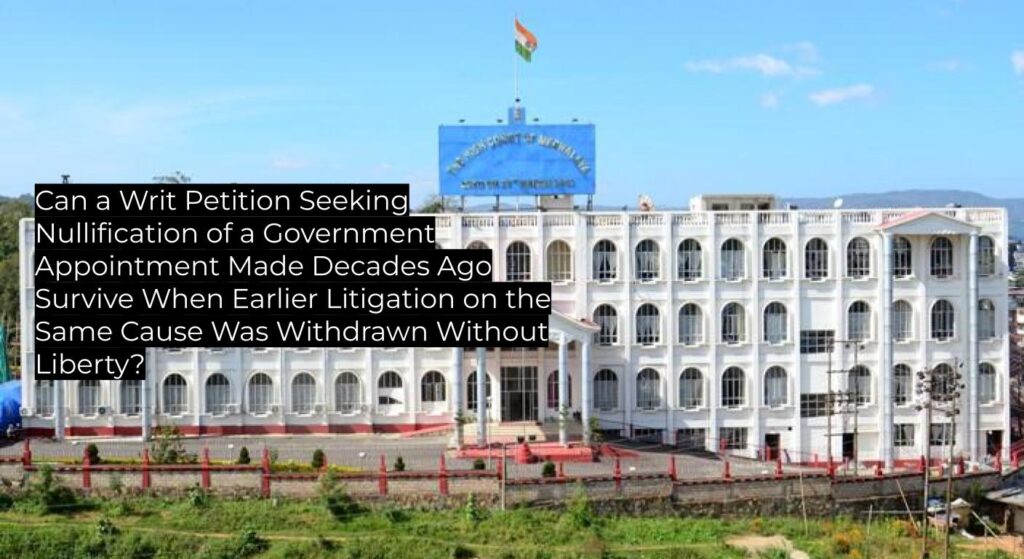
The High Court has held that a writ petition challenging a government appointment from 2002 is not maintainable when an earlier writ on the same issue was withdrawn without liberty to refile. The Court dismissed the petition on grounds of both inordinate delay and res judicata, upholding established precedent. This decision is binding on subordinate courts in Meghalaya and clarifies the procedural bars for challenging old public appointments.
Summary
| Category | Data |
|---|---|
| Case Name |
WP(C)/206/2024 of MAHFUZAR RAHMAN Vs STATE OF MEGHALAYA AND 4 ORS. CNR MLHC010006152024 |
| Date of Registration | 07-06-2024 |
| Decision Date | 10-09-2025 |
| Disposal Nature | Dismissed |
| Judgment Author | Hon’ble Mr. Justice H. S. Thangkhiew, Chief Justice (Acting) |
| Court | High Court of Meghalaya |
| Bench | Single Bench (Hon’ble Mr. Justice H. S. Thangkhiew, Chief Justice (Acting)) |
| Precedent Value | Binding on subordinate courts in Meghalaya; persuasive in other jurisdictions |
| Overrules / Affirms | Affirms existing principles of res judicata and delay (laches) |
| Type of Law | Service Law / Civil Procedure (procedural bars) |
| Questions of Law | Whether a writ petition challenging an appointment made in 2002 is maintainable after an earlier writ on the same cause was withdrawn without liberty to refile, and whether such challenge is barred by delay and res judicata. |
| Ratio Decidendi | The High Court held that when a petitioner has previously withdrawn a writ petition on the same cause without seeking liberty to file afresh, any subsequent petition is barred by res judicata. Additionally, attempts to assail a government appointment made as far back as 2002 are liable to be dismissed on the ground of inordinate delay (laches), independently of res judicata. |
| Facts as Summarised by the Court | The writ petitioner challenged the 2002 appointment of Respondent No. 5 as Chowkidar, contending that the appointee was unrelated and that a family member should have been appointed. Previously, the petitioner’s daughter was appointed for a second land donation. The State and Respondent No. 5 argued res judicata due to withdrawal of an earlier writ (WP(C) 262/2021) without liberty. The Court found the challenge barred due to both delay and res judicata. |
Practical Impact
| Category | Impact |
|---|---|
| Binding On | All subordinate courts in Meghalaya |
| Persuasive For | Other High Courts, Supreme Court |
| Follows | Affirms existing precedents on res judicata and laches (delay) |
What’s New / What Lawyers Should Note
- Reaffirms that withdrawal of a writ petition without liberty to refile bars subsequent petitions on the same cause (res judicata).
- Challenge to government appointments after a long lapse (in this case, over two decades) will be dismissed on grounds of delay (laches).
- Lawyers should ensure that if a writ is withdrawn, specific liberty must be sought for future litigation on the same subject; otherwise, fresh petitions will not be entertained.
- Strict approach applied by the court to discourage stale litigation in public service matters.
Summary of Legal Reasoning
- The Court first addressed whether the writ petition was maintainable, in light of the State’s argument that an earlier writ (WP(C) No. 262 of 2021) on the same cause was withdrawn without liberty to refile.
- The Court accepted the submission that, as no liberty was granted to file afresh, the doctrine of res judicata applied, thereby barring fresh proceedings on the same issue.
- Additionally, the Court found that the subject-matter appointment dated back to 2002 and held that such a delayed challenge must be dismissed on the ground of inordinate delay/laches alone.
- Both grounds—res judicata and delay—were found to independently justify dismissal of the writ.
- No new interpretation of statutory provisions or discussion of exceptions was undertaken; the decision strictly applies existing procedural bars.
Arguments by the Parties
Petitioner
- Questioned the validity of the appointment of Respondent No. 5 as Chowkidar in 2002, alleging lack of relationship to the land donor.
- Argued that a family member should have been appointed.
Respondents (State – R1 to R4)
- Submitted the writ was not maintainable as the petitioner had previously withdrawn a similar petition (WP(C) 262/2021) without liberty to refile.
- Asserted that the ground of res judicata alone barred the present writ.
Respondent No. 5
- Supported the State’s position on maintainability.
- Emphasised the petition was challenging an appointment made as far back as 2002.
- Claimed to be a first cousin of the petitioner.
Factual Background
The petitioner had donated two plots of land, seeking government appointments for family members as consideration. For the first plot, Respondent No. 5 was appointed as Chowkidar in 2002, allegedly without any family relationship to the petitioner. For the second plot, the petitioner’s daughter received an appointment in 2002. An earlier writ challenging the first appointment was filed and withdrawn in 2021 without liberty to refile. The present petition sought termination of Respondent No. 5 and fresh appointment from the petitioner’s family.
Statutory Analysis
The judgment applies procedural principles of res judicata (previous litigation precludes subsequent litigation on the same cause without specific liberty) and laches (delay defeats equity in writ jurisdiction). No direct statutory provision from the CPC or any service law was interpreted; rather, established procedural doctrines were applied.
Dissenting / Concurring Opinion Summary
No dissenting or concurring opinions have been recorded; the matter was heard and decided by a single judge.
Procedural Innovations
No procedural innovations or new guidelines have been set in this judgment.
Alert Indicators
- ✔ Precedent Followed – Existing law on res judicata (withdrawal without liberty bars subsequent litigation) and laches (stale claims not entertained) has been strictly applied and reaffirmed.