


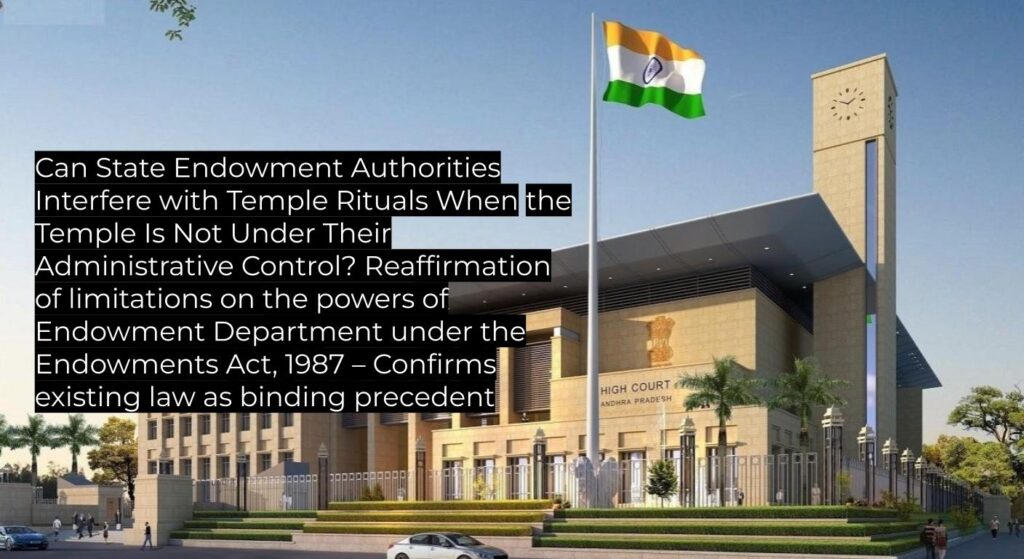
The High Court of Andhra Pradesh clarified that the Endowment Department cannot intervene in the administration or rituals of temples not under its official control. This judgment upholds the established demarcation of administrative authority, with binding effect on all subordinate courts within Andhra Pradesh and persuasive value for similar disputes in other jurisdictions.
Summary
| Category | Data |
|---|---|
| Case Name | WP/24013/2025 of T PRABHUDAS Vs THE STATE OF AP |
| CNR | APHC010471022025 |
| Date of Registration | 08-09-2025 |
| Decision Date | 10-09-2025 |
| Disposal Nature | DISPOSED OF NO COSTS |
| Judgment Author | JUSTICE KIRANMAYEE MANDAVA |
| Court | High Court of Andhra Pradesh |
| Precedent Value | Binding within Andhra Pradesh; persuasive elsewhere |
| Type of Law | Administrative Law / Religious Endowments Law |
| Questions of Law | Whether Endowment Department can interfere with rituals or administration of a temple not under its control. |
| Ratio Decidendi |
The Court found that since the subject temple is not under the control of the Endowment Department, as per instructions furnished, the Department has no authority to interfere in the conduct of temple rituals or festivals. Therefore, the relief sought against Endowment authorities does not merit consideration. However, liberty is granted to the petitioners to approach the Police Department for assistance in maintaining law and order during festivals. |
| Facts as Summarised by the Court |
Petitioners alleged interference by Endowment authorities and villagers in performing traditional festivals and rituals at Sri Sankeswara Swamy Temple, Agali Village. The Department clarified the temple is under the control of Archakas and villagers, not the Endowment Department. Court declined to issue directions but allowed the petitioners to seek police assistance for law and order. |
Practical Impact
| Category | Impact |
|---|---|
| Binding On | All subordinate courts in Andhra Pradesh |
| Persuasive For | Other High Courts, Supreme Court, and administrative tribunals handling endowment disputes |
| Follows | The established statutory scheme under Andhra Pradesh Endowments Act, 1987 |
What’s New / What Lawyers Should Note
- Confirms that Endowment Department officials have no locus to interfere in temples not under their statutory administrative control.
- In such cases, petitioners may be advised to approach law enforcement authorities for issues of law and order during religious functions.
- The Court declined to issue directions against officials whose jurisdiction was statutorily excluded, reinforcing the importance of verifying administrative control before proceeding in similar matters.
Summary of Legal Reasoning
- The High Court considered the petitioner’s allegation that Endowment Department officials, along with certain individuals in the village, were interfering with the performance of rituals and festivities at the temple.
- The respondent authorities, through their counsel, produced instructions establishing that the concerned temple is not governed by the Endowments Department but is under the control of the community and the temple’s Archakas.
- The Court held that, with no statutory or administrative control by the Department, it could not issue writ directions against the respondent Endowment officials.
- Acknowledging potential law and order issues, the Court granted liberty to the petitioners to seek help from the police for protection during the religious festivals.
Arguments by the Parties
Petitioner:
- Alleged interference by respondents 3 to 10 in the conduct of temple rituals and festivals.
- Asserted hereditary right to conduct certain unique rituals and festivals as per tradition.
- Requested writ to prevent such interference and secure free exercise of customary religious functions.
Respondents (Endowment Department):
- Submitted that the temple is not under the administrative control of the Endowments Department.
- Placed on record instructions confirming management by Archakas and villagers, not by Department authorities.
Factual Background
The petitioners are associated with Sri Sankeswara Swamy Temple in Agali Village, asserting hereditary roles relating to ritual and festival performance. They complained of interference by certain villagers and Endowment Department officials in the conduct of festivals and traditional rituals. The Endowment Department clarified through instructions to the Court that the temple is not under its control but managed by the Archakas and villagers. The petition sought to restrain such interference and to direct authorities not to disturb the performance of religious festivals and rituals.
Statutory Analysis
- The Court considered the administrative framework under the Andhra Pradesh Endowments Act, 1987.
- Found no provision assigning administrative control over the subject temple to the Endowment Department, based on records and instructions provided.
- Concluded that in the absence of statutory jurisdiction, no directions could be issued against the Endowment authorities.
Dissenting / Concurring Opinion Summary
No dissenting or concurring opinions were recorded in the judgment.
Procedural Innovations
- The Court expressly granted liberty to the petitioners to approach the police for assistance in ensuring law and order during the festivals, clarifying a remedy in the absence of Endowment Department jurisdiction.
Alert Indicators
- ✔ Precedent Followed – The ruling reaffirms existing boundaries and jurisdiction under the Endowments Act.