


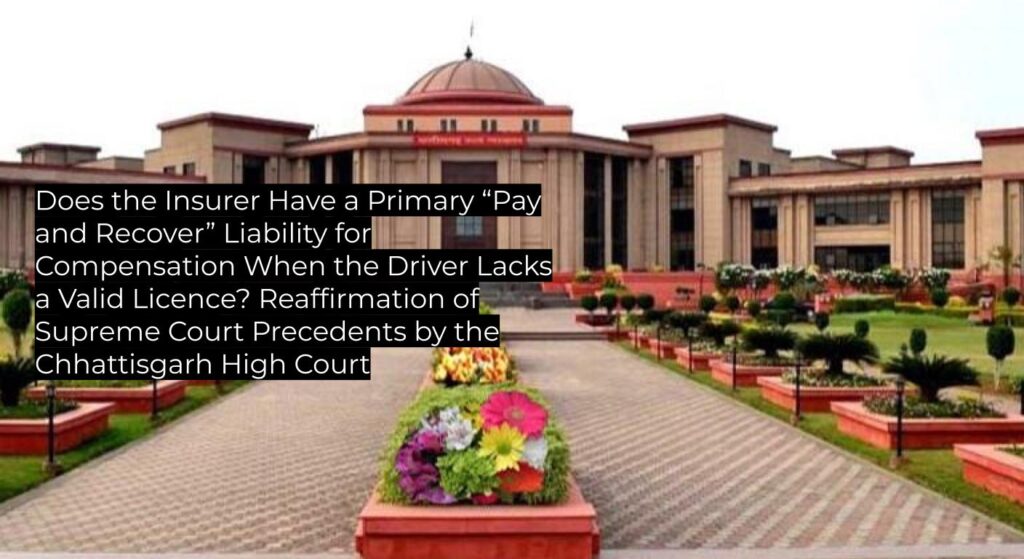
The Chhattisgarh High Court confirms that when a vehicle’s driver was unlicensed at the time of accident, the insurer must first pay the compensation to the claimants and may then recover the amount from the vehicle’s owner, in line with Supreme Court authorities. This judgment upholds binding precedent for Motor Accident Claim cases in Chhattisgarh, ensuring claimants’ prompt relief while retaining the insurer’s right of recovery.
Summary
| Category | Data |
|---|---|
| Case Name | MAC/728/2022 of SANTOSHI CHAKRADHARI Vs RAM DAS KUMHAR |
| CNR | CGHC010204142022 |
| Date of Registration | 24-06-2022 |
| Decision Date | 10-09-2025 |
| Disposal Nature | PARTLY ALLOWED |
| Judgment Author | Hon’ble Shri Justice Sanjay K. Agrawal |
| Court | High Court Of Chhattisgarh |
| Bench | Single Bench |
| Precedent Value | Binding within Chhattisgarh; authoritative on the pay and recover issue for subordinate courts |
| Overrules / Affirms | Affirms Supreme Court precedent (Swaran Singh, Shamanna, Laxmi Narain Dhut, Nanjappan) |
| Type of Law | Motor Vehicles Act – Compensation Claims |
| Questions of Law |
|
| Ratio Decidendi |
The court held that, even where a driver is found unlicensed and the insurer is technically exonerated, binding Supreme Court precedent requires a “pay and recover” order. The insurer must pay the claimants the awarded compensation, then recover it from the owner/driver. The court also held that, for purposes of computing compensation, the deceased’s income should not be reckoned below Bengal Minimum Wages Notification if evidence supports such employment. Further, filial consortium compensation is awardable according to established precedent. |
| Judgments Relied Upon |
|
| Logic / Jurisprudence / Authorities Relied Upon by the Court |
|
| Facts as Summarised by the Court | Deceased (a mason) died in a motor accident. The owner’s motorcycle was involved; driver was unlicensed. Original tribunal awarded Rs.2,45,000, exonerated insurer, and did not direct “pay and recover.” Claimants appealed seeking enhanced compensation and “pay & recover” direction. |
Practical Impact
| Category | Impact |
|---|---|
| Binding On | All Motor Accident Claims Tribunals and subordinate courts in Chhattisgarh |
| Persuasive For | Other High Courts, especially where similar facts exist |
| Follows |
|
What’s New / What Lawyers Should Note
- The High Court reiterates that regardless of the driver’s lack of valid licence, the insurer is duty-bound to pay compensation to the claimants first, and then recover the sum from the insured owner/driver (“pay and recover”)—claimants need not pursue the owner.
- For deceased persons working as skilled or semi-skilled labour (here, a mason), compensation must consider statutory minimum wage notifications, not arbitrary lower figures.
- Compensation for loss of filial consortium (for deceased’s child) is mandatory, per latest Supreme Court precedents, not optional.
- Where claim tribunals fail to give “pay and recover” directions, the High Court will set it right on appeal in line with Supreme Court rulings.
Summary of Legal Reasoning
- The Tribunal had erred in assessing the deceased’s income below the statutory minimum wage notified for masons by the Chhattisgarh Labour Commissioner; the correct wage must be used.
- Citing National Insurance Co. Ltd. v. Pranay Sethi, Sarla Verma, and Magma General Insurance, the court recalculated pecuniary and consortium losses, including for filial consortium.
- The Tribunal had not ordered the insurance company to “pay and recover” due to the driver’s lack of licence. The High Court relied on the Supreme Court’s binding decisions in Shamanna, Swaran Singh, Laxmi Narain Dhut, and Nanjappan to hold that regardless of breach conditions by the insured/driver, the insurer must first pay the claimants, then recover from owner/driver.
- The recovery process does not require the insurer to file a fresh suit; the insurer may recover the amount as if the insurance/owner dispute was decided by the tribunal.
- On the basis of these authorities, the appeal was partly allowed, compensation enhanced, and a clear “pay and recover” direction given.
Arguments by the Parties
Petitioner (Appellants):
- Tribunal erred by under-assessing deceased’s income (should be as per statutory minimum wage for masons—Rs.8,960/month).
- No compensation awarded for loss of filial consortium to Appellant No.2 (the deceased’s son); Rs.44,000/- should be awarded.
- Tribunal failed to direct insurer to “pay and recover” though driver was uninsured.
- Prayed for enhancement of compensation and “pay and recover” direction.
Respondent (Insurance Company):
- Compensation as awarded by Tribunal is just and proper; no interference is needed.
- Not necessary to pass “pay and recover” direction in the facts of this case; Tribunal’s exoneration correct.
- Appeal should be dismissed.
Factual Background
The deceased, a mason, died in a road accident involving a motorcycle owned by Respondent No.2 and driven by Respondent No.1, who lacked a valid licence. The Claims Tribunal awarded Rs.2,45,000 as compensation, payable by the owner and driver, exonerating the insurer and passing no “pay and recover” order. The claimants (widow and son) appealed seeking higher compensation in line with minimum wage notifications and sought an order making the insurer first pay the compensation and then recover it from the owner/driver.
Statutory Analysis
- Section 173, Motor Vehicles Act, 1988: Governing appeals to the High Court from MACT awards.
- Relevant Minimum Wages Notification, Chhattisgarh: Used for fair income assessment of deceased skilled workers.
Dissenting / Concurring Opinion Summary
No dissenting or concurring opinions were delivered in this single bench judgment.
Procedural Innovations
No new procedural innovations or guidelines were set out by the High Court in this judgment, other than reiterating the mechanism for insurer recovery as stipulated by the Supreme Court.
Alert Indicators
- ✔ Precedent Followed – When existing law is affirmed.