


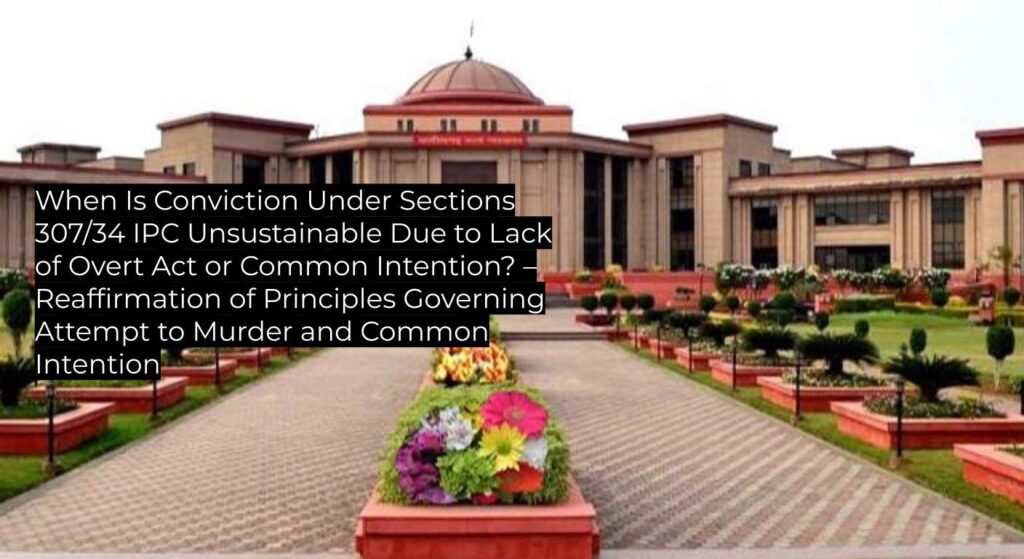
The Chhattisgarh High Court clarifies that, for conviction under Sections 307/34 IPC, clear overt acts and common intention must be established against each accused; general allegations are insufficient. The decision applies and affirms binding precedents and provides an authoritative restatement for criminal defence practice and trial courts.
Summary
| Category | Data |
|---|---|
| Case Name |
|
| Date of Registration | 02-06-2008 |
| Decision Date | 10-09-2025 |
| Disposal Nature | ALLOWED |
| Judgment Author | HON’BLE SMT. JUSTICE RAJANI DUBEY |
| Court | High Court of Chhattisgarh |
| Bench | Single Judge Bench (Justice Rajani Dubey) |
| Precedent Value | Binding within Chhattisgarh; strong persuasive value elsewhere |
| Overrules / Affirms |
|
| Type of Law | Criminal Law – Substantive and Procedural |
| Questions of Law |
|
| Ratio Decidendi | The Court reaffirmed that conviction under Sections 307/34 IPC requires proof of specific overt acts and common intention among co-accused. Mere general or omnibus allegations are inadequate, especially where medical and witness evidence only supports individual acts. The assessment of intention should consider the nature of weapon, injury, and conduct, as laid down by the Supreme Court. Where the prosecution fails to establish the requisite intention or participation, acquittal is warranted. |
| Judgments Relied Upon |
|
| Logic / Jurisprudence / Authorities Relied Upon by the Court | Detailed analysis of intention, overt act, Section 307 elements, and application of Section 34 IPC based on cited Supreme Court jurisprudence. |
| Facts as Summarised by the Court | The incident involved an attack on the victim by multiple accused with sharp weapons. The complainant specifically alleged assault against Mahesh and a juvenile; no specific overt act was attributed to Vidhan Shrivastava and Indivar Khare. Medical evidence indicated grievous injuries, but only to support acts of Mahesh and the juvenile. Several witnesses turned hostile. Trial court convicted under Sections 307/34 and 506-B IPC. |
Practical Impact
| Category | Impact |
|---|---|
| Binding On | All subordinate courts in Chhattisgarh |
| Persuasive For | Other High Courts; relevant for Supreme Court consideration |
| Follows |
|
What’s New / What Lawyers Should Note
- Reiterates that conviction under Sections 307/34 IPC can only be sustained where specific, overt acts and clear common intention are proven against each accused.
- General allegations or omnibus statements by victims are insufficient to sustain conviction for attempt to murder with the aid of Section 34 IPC.
- Courts must consider the nature of injuries, weapon used, and conduct of each accused when assessing common intention and participation.
- Acquittal is proper where evidence only implicates some co-accused, and medical or witness testimony does not support generalized allegations.
- Defence practitioners can cite this judgment to oppose omnibus or non-specific allegations in serious criminal trials.
Summary of Legal Reasoning
- The Court reviewed the requirements for conviction under Section 307 (attempt to murder), emphasizing intention and overt acts, drawing on Supreme Court jurisprudence (Shoyeb Raja, Kanha, Hari Mohan Mandal).
- It reasoned that while the presence of grievous injuries may assist in inferring intention, ultimate conviction rests on overt acts attributable to each accused and demonstration of common intention under Section 34.
- The Court distinguished between those against whom specific acts were established (Mahesh and the juvenile) and others (Vidhan and Indivar) who were not shown to have participated via credible evidence; therefore, conviction could not stand.
- Section 34’s requirements were re-examined in light of the facts: the complainant’s own statement did not assign particular roles or acts to Vidhan and Indivar.
- Cited authorities required an evaluation of the medical, factual, and testimonial record to ascertain individual liability rather than collective guilt on vague assertions.
Arguments by the Parties
Petitioner (Vidhan Shrivastava and Indivar Khare):
- The conviction and sentence are unsustainable as there are no specific allegations or evidence of overt acts against them.
- Name(s) not initially mentioned in the FIR; implication is subsequent and unfounded.
- Key prosecution witnesses did not support the prosecution case—most turned hostile; contradictions and omissions present.
- Cited Supreme Court and High Court authorities requiring clear proof of overt acts and common intention.
Respondent-State and Objector:
- Supported the trial court’s decision, asserting that the prosecution case was proved beyond reasonable doubt.
- Argued conviction was appropriate based on oral and documentary evidence.
Factual Background
The incident occurred on 01.07.2004, when the victim Abhishek Kumar Singh was attacked with sharp weapons by several accused, including a juvenile, at Bharat Kirana Store. The FIR alleged serious injuries intended to cause death. Accusations specifically implicated Mahesh and the juvenile; the complainant’s statements did not assign any specific overt acts to Vidhan Shrivastava and Indivar Khare. Several material witnesses later turned hostile. The trial court convicted the accused under Sections 307/34 and 506-B IPC.
Statutory Analysis
- Section 307 IPC: Requires intention or knowledge tantamount to murder, with an overt act towards its commission; not limited to the nature of injuries caused, but determined by intention, weapon used, and manner of assault.
- Section 34 IPC: Imposes joint liability where a criminal act is done in furtherance of common intention, but each accused’s participation and intent must be demonstrably established; the section’s operation depends on evidence of simultaneous consensus or a meeting of minds, which can develop spontaneously but must be shown on facts.
- Section 506-B IPC: Relating to criminal intimidation by threat of death or grievous hurt.
- Section 481 of BNSS 2023: Regarding bail obligations upon acquittal in appeal (bond/undertaking requirements).
Dissenting / Concurring Opinion Summary
No dissenting or concurring opinions were recorded in the judgment.
Procedural Innovations
- The Court, applying Section 481 of BNSS 2023, directed acquitted appellants to furnish a personal bond and undertaking in accordance with current procedural law, pending possible Supreme Court appeal.
Alert Indicators
- ✔ Precedent Followed – Existing Supreme Court and High Court authorities affirmed and applied.