


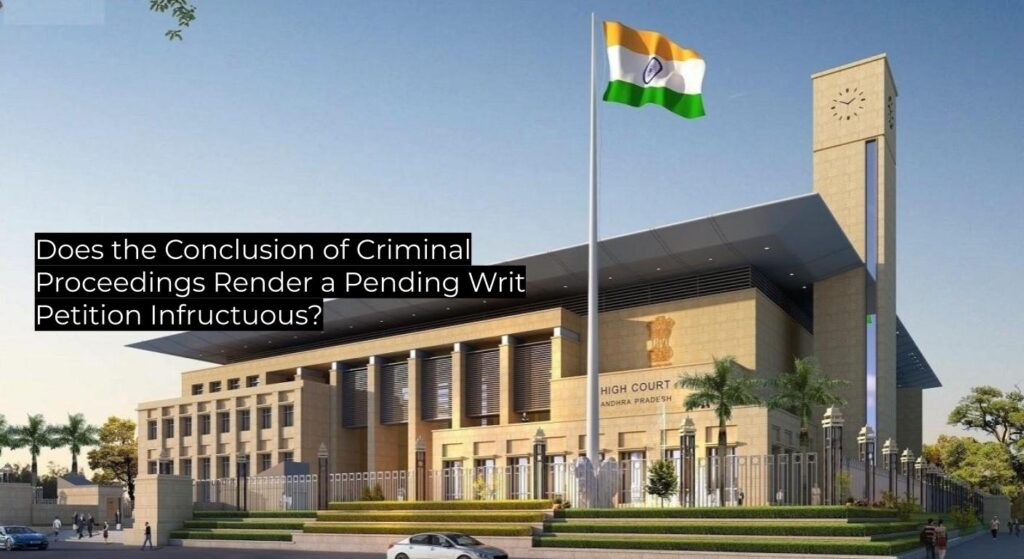
The Andhra Pradesh High Court has held that a writ petition seeking action against police inaction in investigating an FIR becomes infructuous if, during its pendency, a final order is passed in the criminal proceedings arising from the same FIR. This judgment reaffirms existing precedent and confirms that such writs cannot proceed once petitioners are acquitted in the connected criminal case. The ruling is binding on subordinate courts within Andhra Pradesh and clarifies procedural outcomes for future similar cases.
| Category | Data |
|---|---|
| Case Name | WP/40345/2018 of Buddika Audemma Vs The State of Andhra Pradesh |
| CNR | APHC010836332018 |
| Date of Registration | 08-11-2018 |
| Decision Date | 10-09-2025 |
| Disposal Nature | DISMISSED AS INFRUCTUOUS |
| Judgment Author | Justice B.V.L.N. Chakravarthi |
| Court | High Court of Andhra Pradesh |
| Bench | Single Judge Bench |
| Precedent Value | Binding within Andhra Pradesh |
| Type of Law |
|
| Ratio Decidendi |
The Court held that where a writ petition complains of police inaction in relation to a registered FIR, and criminal proceedings (including trial and acquittal) are completed during the pendency of such petition, the cause of action ceases to survive, rendering the writ petition infructuous. The court accepted the submissions of the State that investigation was concluded, charge sheet filed, trial conducted, and petitioners acquitted—hence, the writ’s purpose no longer persists. No directions were issued as the relief claimed had become academic. |
| Facts as Summarised by the Court |
Petitioners sought a writ of mandamus for police action in FIR No. 28/2018, alleging unlawful interference with their property. The State submitted that a charge sheet was filed, trial conducted, and petitioners acquitted on 27.06.2020. The petition was thus dismissed as infructuous. |
Practical Impact
| Category | Impact |
|---|---|
| Binding On | All subordinate courts in Andhra Pradesh |
| Persuasive For | Other High Courts, especially on procedural disposal after conclusion of underlying criminal matter |
What’s New / What Lawyers Should Note
- Reaffirms that writ petitions seeking mandamus for police action on a completed FIR become infructuous if a trial is completed and petitioners are acquitted during the pendency of the writ.
- Clarifies that courts will not entertain or continue such writ petitions when primary proceedings have reached finality.
- Highlights the necessity to monitor the status of criminal proceedings parallel to writ petitions concerning police inaction.
Summary of Legal Reasoning
- The Court considered whether a writ of mandamus demanding police action on an FIR survives when the underlying criminal case has concluded.
- The State submitted (by written instructions) that investigation had led to a chargesheet and a full-fledged trial, at the end of which the petitioners were acquitted.
- The judge determined that, since the criminal justice process had run its course, the grounds for the writ no longer remained, making the petition infructuous.
- The writ was thus dismissed without adjudicating on the original issues, and without costs.
- No further directions were necessary as no live dispute persisted.
Arguments by the Parties
Petitioner
- Sought writ of mandamus directing police to take action against unofficial respondents for interference with their property, as per FIR No.28/2018.
Respondent (State)
- Submitted that investigation was completed, charge sheet filed, and after trial, petitioners were acquitted on 27.06.2020.
Factual Background
The petitioners alleged police inaction regarding FIR No. 28/2018, which concerned purported interference with their agricultural property. While the writ petition for mandamus was pending, the police completed the investigation, filed a charge sheet, and conducted a trial resulting in the acquittal of the petitioners on 27.06.2020. The outcome of these criminal proceedings rendered the writ petition unnecessary.
Statutory Analysis
- The judgment was rendered in the exercise of writ jurisdiction under Article 226 of the Constitution of India.
- No substantive statutory interpretation or reading down other than applying the doctrine of infructuousness upon conclusion of the criminal proceedings.
Procedural Innovations
No new procedural guidelines or innovations were set out in the judgment.
Alert Indicators
- ✔ Precedent Followed – The decision follows and reiterates existing law regarding the dismissal of writ petitions as infructuous when underlying criminal matters are concluded.