


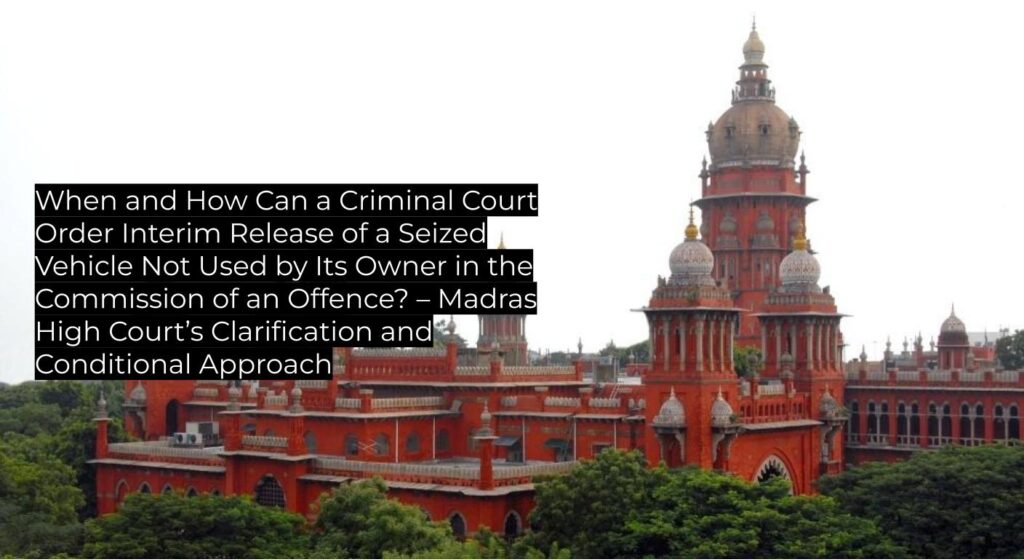
Madras High Court upholds that courts may direct the interim return of a seized vehicle to a non-accused registered owner, subject to conditions, particularly when the owner was not involved in the alleged offence and prolonged impoundment would cause undue hardship. This stands as binding precedent for subordinate courts in Tamil Nadu and further clarifies procedural fairness in similar criminal revisions involving seized property.
Summary
| Category | Data |
|---|---|
| Case Name | CRL RC/1425/2024 of RAMU.R Vs THE STATE REP BY |
| CNR | HCMA011499342024 |
| Date of Registration | 27-08-2024 |
| Decision Date | 02-09-2025 |
| Disposal Nature | DISPOSED OF |
| Judgment Author | HONOURABLE MRS.JUSTICE T.V.THAMILSELVI |
| Court | Madras High Court |
| Precedent Value | Binding on subordinate courts in Tamil Nadu |
| Type of Law | Criminal Procedure (Property Seizure and Release) |
| Questions of Law | Whether a vehicle seized in a murder case can be returned to a non-accused registered owner, subject to conditions, during trial? |
| Ratio Decidendi |
The court held that interim release of a seized vehicle to a non-accused registered owner is permissible on appropriate conditions, especially when impoundment causes undue hardship and the owner had no involvement in the alleged offence. The court observed that the petitioner was not arrayed as an accused, the vehicle rightfully belonged to him, and he was willing to comply with court-imposed conditions. The prolonged open-yard impoundment causing damage was considered. Accordingly, the vehicle was ordered to be released on specific conditions, protecting both the interests of justice and the rights of the property owner. |
| Facts as Summarised by the Court |
Petitioner, a 62-year-old senior citizen, is the registered owner of a four-wheeler which was used by, and lent to, a third party who then allegedly used it in a murder offence without the petitioner’s knowledge. Vehicle was seized by police and kept in open yard for over two years, leading to damage. Petitioner not arrayed as accused and sought return, but trial court refused. |
Practical Impact
| Category | Impact |
|---|---|
| Binding On | All subordinate criminal courts in Tamil Nadu |
| Persuasive For | Other High Courts in India for similar facts |
What’s New / What Lawyers Should Note
- Madras High Court affirms interim release of a vehicle seized in a criminal case where the owner is not an accused and asserts proprietary rights.
- Court’s order is conditional: vehicle not to be alienated or encumbered; must be produced when required; requires substantial cash security.
- Prolonged police custody causing damage to the property is a significant consideration favoring interim release.
- Lawyers may rely on this precedent for owners not implicated in the alleged offence to seek return of their property, subject to compliance with court conditions.
Summary of Legal Reasoning
- The court considered the petitioner’s status as the registered owner, fact that he was not arrayed as an accused, and representations that use of the vehicle in the offence was without his knowledge.
- Noted practical hardship caused by prolonged impoundment: vehicle kept in open yard over two years, leading to damage.
- Observed that the prosecution confirmed the petitioner’s ownership and did not dispute his non-involvement.
- The court balanced the needs of the investigation and potential evidence with the owner’s rights, and imposed protective conditions to secure the property and ensure its availability for the proceedings.
- The judicial inclination is to prevent undue hardship and wastage of property when ownership is undisputed, and there is no implication of the owner in the crime.
Arguments by the Parties
Petitioner
- Petitioner is the owner; vehicle was lent to the accused without his knowledge of any criminal intent.
- Not arrayed as an accused in the criminal case.
- Prolonged impoundment is causing damage to the vehicle.
- Willing to comply with any court-imposed conditions for release.
Respondent / State
- Confirmed vehicle ownership lies with petitioner.
- No specific opposition to conditional release as per the order.
Factual Background
The petitioner, a 62-year-old senior citizen, owned a Tata Indica vehicle. He lent his vehicle to the first accused (A1), who allegedly used it in the commission of an offence under Section 302 IPC. The vehicle was seized and kept in the police station open yard for more than two years, suffering damage. The petitioner was not listed as an accused and sought the vehicle’s return, which was denied by the trial court, leading to the criminal revision before the Madras High Court.
Statutory Analysis
The court acted under Sections 397 and 401 of the Code of Criminal Procedure, governing revisionary powers. The application for return of property is addressed via Section 451/457 CrPC contextually, focusing on the power of the court to pass interim custody and disposal orders for property during the pendency of proceedings. No narrow or expansive statutory reinterpretation is noted, but the judgment highlights well-established procedural discretion.
Procedural Innovations
- The judgment reiterates and applies established procedure for interim custody of seized property, including specific protective conditions (non-alienation, production as required, cash security).
- No new procedural rules or guidelines are set; the order exemplifies judicial discretion suited to the facts.
Alert Indicators
- ✔ Precedent Followed – Reaffirms and applies existing law on interim release of seized property to non-accused owners with protective conditions.