


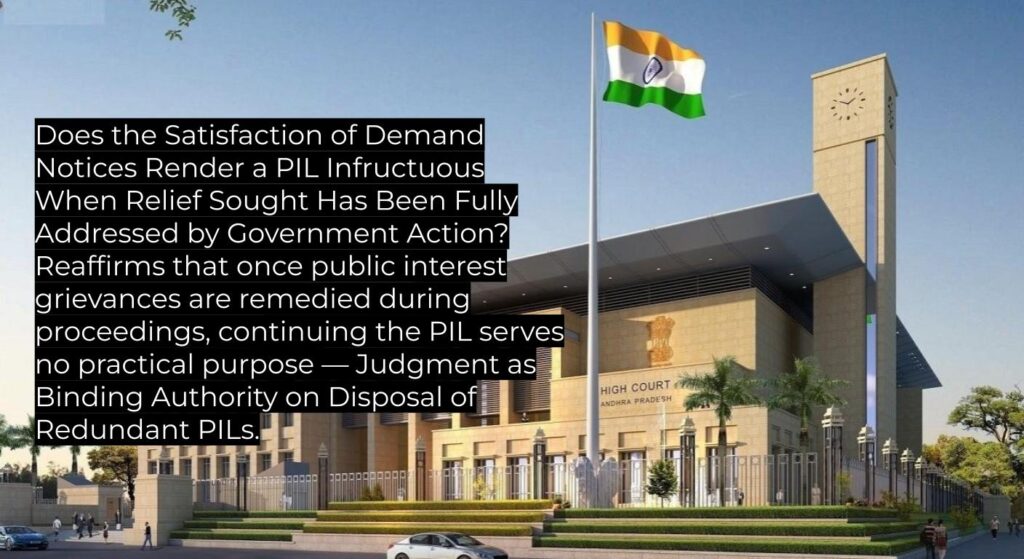
Where departmental action during PIL pendency leads to complete satisfaction of relief sought (including resolution by payment or relevant party’s demise), the High Court closes the petition as nothing survives. This reinforces existing precedent on the disposability of infructuous PILs, with sectoral implications for mining revenue disputes and similar regulatory enforcement cases.
Summary
| Category | Data |
|---|---|
| Case Name | WP(PIL)/106/2022 of B Venkatehwara Rao Vs The State of Andhara Pradesh, CNR APHC010272262022 |
| Date of Registration | 05-07-2022 |
| Decision Date | 02-09-2025 |
| Disposal Nature | CLOSED NO COSTS |
| Judgment Author | DHIRAJ SINGH THAKUR, CJ |
| Concurring or Dissenting Judges | CHALLA GUNARANJAN, J (Concurring) |
| Court | High Court of Andhra Pradesh |
| Bench | The Chief Justice DHIRAJ SINGH THAKUR, Justice CHALLA GUNARANJAN |
| Precedent Value | Binding authority within Andhra Pradesh on disposal of infructuous/redundant PILs |
| Type of Law | Public Interest Litigation; Administrative Law |
| Questions of Law | Whether a PIL is to be closed as infructuous when the relief claimed is satisfied during petition pendency |
| Ratio Decidendi | The High Court held that since two of the three demand notices raised for regulatory violations were satisfied with payment and the third alleged violator had deceased, there remained no outstanding grievance to address in the PIL. Accordingly, the petition stood closed, reinforcing that PILs should not continue where their purpose has been fully met by governmental action. |
| Facts as Summarised by the Court | The petitioner challenged non-satisfaction of demand notices issued for violations by three individuals. During the case, two parties complied by paying, and the third passed away. No further grievance subsisted. |
Practical Impact
| Category | Impact |
|---|---|
| Binding On | All subordinate courts in Andhra Pradesh; public authorities managing compliance |
| Persuasive For | Other High Courts with similar facts or regulatory enforcement scenarios |
What’s New / What Lawyers Should Note
- Confirms that a PIL loses purpose and must be closed when governmental action addresses the underlying grievance during litigation.
- Sets a precedent for expeditious disposal of PILs rendered infructuous by subsequent compliance or change in circumstances.
- No costs imposed, reflecting judicial restraint where public interest relief is voluntarily complied with by respondents.
Summary of Legal Reasoning
- The Court evaluated the core issue — demand notices issued for regulatory violations.
- It recorded the Government Pleader’s representation that compliance had occurred in respect of two parties and the third party was deceased.
- The Court found no surviving grievance and thus, applied the principle that continuation of a PIL serves no practical purpose once relief is provided.
- It ordered closure of the petition accordingly, without imposition of costs, and directed closure of miscellaneous pending applications.
Arguments by the Parties
Petitioner:
- Highlighted violations by three named individuals and alleged non-satisfaction of government demand notices.
Respondents (Government Pleader for Mines and Geology Department):
- Informed the Court that two of the three demand notices had been complied with through payment.
- Stated that the third individual (P. Atchamma) had passed away.
Factual Background
The PIL was filed alleging that three individuals had violated mining regulations, resulting in issuance of demand notices by the government. The petitioner’s grievance was the non-satisfaction of these notices by the alleged violators. During the pendency of proceedings, payment was made in respect of two parties; the third alleged violator died. With no surviving actionable grievance, only superfluous matters remained.
Statutory Analysis
The judgment is silent on interpretation of specific statutory provisions. The Court focused on the administrative enforcement and penalty collection in the context of mining regulation, but only in relation to whether full compliance rendered the PIL infructuous.
Dissenting / Concurring Opinion Summary
There is concurrence among both judges (Chief Justice DHIRAJ SINGH THAKUR and Justice CHALLA GUNARANJAN). No separate concurring or dissenting opinion was delivered.
Procedural Innovations
None noted in the judgment.
Alert Indicators
- ✔ Precedent Followed – Judgment affirms and reinforces the standard approach to disposal of infructuous PILs upon satisfaction of relief during litigation.
Citations
No external case law citations or reportable citation numbers provided in the judgment.