


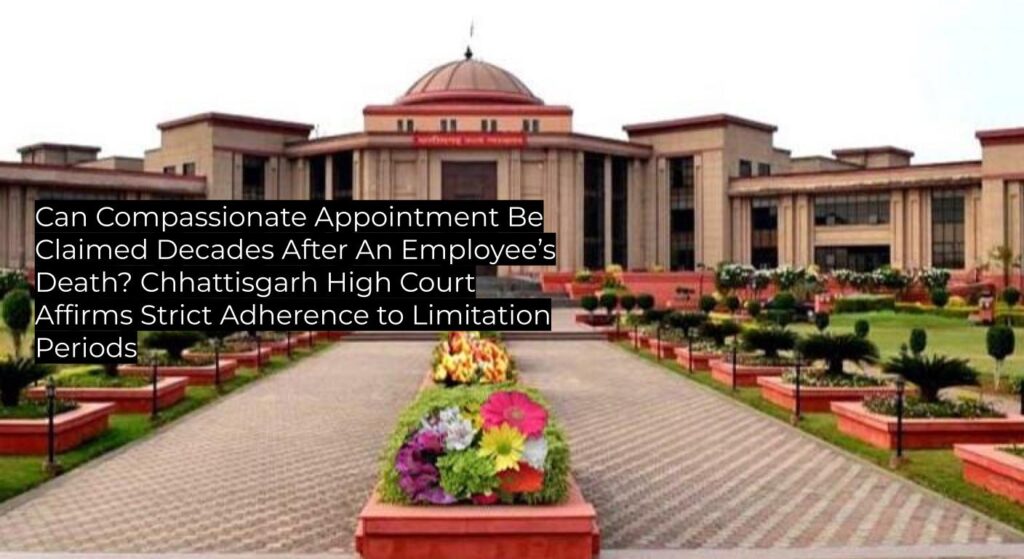
The Chhattisgarh High Court reiterates that compassionate appointment is intended solely as immediate relief for dependents in distress and cannot be claimed after an inordinate delay; a 19-year delay is fatal regardless of circumstances. The Court upholds Supreme Court precedent and the express terms of relevant policy, confirming strict limitation periods as binding precedent for future cases involving government service claims.
Summary
| Category | Data |
|---|---|
| Case Name | WPS/4707/2021 of KU. HIMMANI DHANELIYA Vs STATE OF CHHATTISGARH |
| CNR | CGHC010214752021 |
| Date of Registration | 27-08-2021 |
| Decision Date | 02-09-2025 |
| Disposal Nature | DISMISSED |
| Judgment Author | HON’BLE SHRI JUSTICE RAKESH MOHAN PANDEY |
| Court | High Court of Chhattisgarh at Bilaspur |
| Precedent Value | Binding for subordinate courts in Chhattisgarh; strong persuasive value elsewhere |
| Overrules / Affirms | Affirms Supreme Court precedents |
| Type of Law | Service Law / Employment Law (Compassionate Appointment) |
| Questions of Law | Whether a dependent can seek compassionate appointment nearly two decades after the employee’s death in harness, citing administrative delays as justification. |
| Ratio Decidendi |
Compassionate appointment is an exception to normal recruitment, aimed only to provide immediate relief to bereaved families. The extraordinary lapse of 19 years between the employee’s demise and the application defeats the object and cannot be condoned, even if official delays contributed. Extant policy prescribes a limitation period (3 years, extendable by 1 more), which is binding and not merely procedural. Reliance is placed on Supreme Court precedents emphasizing “immediate amelioration” as the decisive criterion. As the family survived for 19 years, the eligibility for such appointment extinguishes; administrative hardship does not override the core object of the scheme. |
| Judgments Relied Upon |
|
| Logic / Jurisprudence / Authorities Relied Upon by the Court |
|
| Facts as Summarised by the Court |
Father of petitioner (Assistant Teacher) died in harness in 2002; petitioner’s mother sought benefits in 2004; second service-book (needed because original was destroyed in a 2000 naxal attack) was finally prepared in 2021, when payment of dues was made. Petitioner applied for compassionate appointment in 2021 (19 years post demise); application rejected for delay. |
| Citations |
|
Practical Impact
| Category | Impact |
|---|---|
| Binding On | All subordinate courts and administrative authorities in Chhattisgarh |
| Persuasive For | Other High Courts and the Supreme Court |
| Follows |
|
What’s New / What Lawyers Should Note
- Reinforces that administrative hardships or delays (such as reconstruction of service books due to force majeure) do not extend the limitation period for compassionate appointments under existing policy.
- Reiterates that the core purpose of compassionate appointment is immediate post-bereavement relief, not deferred or eventual employment.
- Explicitly affirms Supreme Court precedent that belated claims (even with mitigating circumstances) are fatal if policy limitation is exceeded.
- Lawyers representing dependents in service law matters must advise strict compliance with prescribed time-limits, irrespective of extenuating factors.
Summary of Legal Reasoning
- The court first recounted the facts and established undisputed delay: the petitioner became eligible (attained majority) in 2003 but applied only in 2021, almost 19 years after the employee (her father) died in harness.
- The petitioner’s reason—that official delay in reconstructing records caused the family’s late application—was noted but not found sufficient.
- The Court cited recent Supreme Court judgments:
- State of Maharashtra & Anr. v. Ms. Madhuri Maruti Vidhate clarified that compassionate appointment is intended as immediate relief and that claims after many years are contrary to its object and unsustainable.
- Punjab State Power Corp. Ltd v. Nirval Singh stressed both the need to avoid delay and the impermissibility of considering late applications, even if policy changes or earlier delays are pleaded.
- The High Court applied these rulings and the relevant policy, observing a strict time-limit (3 years, extendable to 4) for making such claims.
- Since the family had survived for many years and was already provided posthumous benefits, the core purpose of the scheme had been achieved, and further relief was unwarranted.
- The writ petition was therefore dismissed, upholding both policy and Supreme Court precedent.
Arguments by the Parties
Petitioner
- The family could not apply earlier because the father’s service-book was destroyed in a naxal attack in 2000, causing long administrative delay in reconstructing records and processing service benefits.
- Payment of terminal dues was made only after 20 years, in 2021; hence, compassionate appointment ought to be considered in light of these unique circumstances.
Respondent (State)
- The applicant’s father died in 2002; yet, the application for compassionate appointment was made only in 2021.
- The application was rightly rejected on grounds of gross delay and laches, as per the limitation prescribed in policy.
Factual Background
The petitioner’s father, an Assistant Teacher in a government primary school, died in harness on 15.06.2002. The family’s efforts to receive death-cum-retirement benefits were impeded by the destruction of the original service-book during a naxal attack in 2000. Reconstruction of records led to a delay, and dues were eventually paid in 2021 after the second service-book was completed. The petitioner, having attained majority in 2003, applied for compassionate appointment only in June 2021—over 19 years after her father’s death. The application was denied for delay.
Statutory Analysis
- The relevant service policy provided a 3-year limitation (extendable by 1 year) for filing applications for compassionate appointment.
- The Court interpreted this time limit strictly, holding that it is binding and not subject to extension based on administrative difficulty.
- The purpose of the policy—to grant immediate financial succor to bereaved families—was central to the statutory construction.
- No constitutional provisions were invoked or analyzed.
Dissenting / Concurring Opinion Summary
No dissenting or concurring opinions are recorded in the judgment.
Procedural Innovations
No procedural innovations or new guidelines were set by the Court in this judgment.
Alert Indicators
- ✔ Precedent Followed – Existing Supreme Court law on delay in compassionate appointments affirmed.
Citations
- State of Maharashtra & Anr. v. Ms. Madhuri Maruti Vidhate, AIROnLine 2022 SC 471 (paras 7–8)
- Punjab State Power Corporation Ltd & Ors. v. Nirval Singh, (2019) 6 SCC 774 (paras 7–9)