


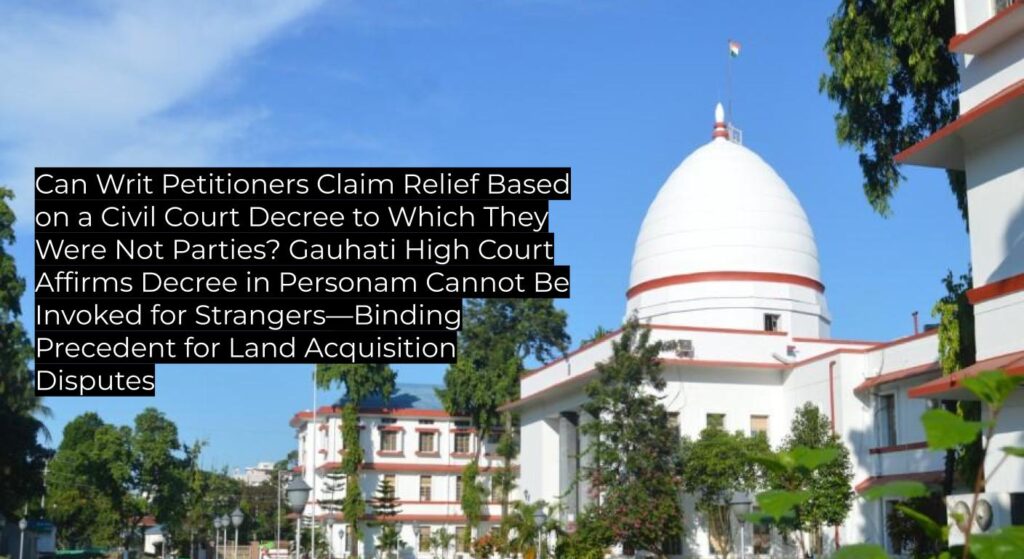
The Gauhati High Court clarified that decrees passed in civil suits regarding land ownership are decrees in personam, binding only the parties to the suit, and cannot confer rights on third parties through a writ petition. Prior civil decrees in favor of similarly situated individuals do not create automatic entitlement or immunity against eviction for non-parties. This judgment upholds established principles, reinforcing the distinction between decrees in personam and decrees in rem, and is binding on subordinate courts within Assam, Nagaland, Mizoram, and Arunachal Pradesh.
Summary
| Category | Data |
|---|---|
| Case Name | WP(C)/3784/2017 of Sahjahan Ali and 36 Ors. Vs The Union of India and 5 Ors. |
| CNR | GAHC010028312017 |
| Date of Registration | 20-06-2017 |
| Decision Date | 03-09-2025 |
| Disposal Nature | Dismissed |
| Judgment Author | Honourable Mr. Justice Sanjay Kumar Medhi |
| Court | Gauhati High Court |
| Bench | Single Judge |
| Precedent Value | Binding on subordinate courts within Gauhati High Court’s jurisdiction |
| Overrules / Affirms | Affirms established doctrine regarding decrees in personam and rights of non-parties |
| Type of Law | Civil, Land Acquisition, Writ Jurisdiction |
| Questions of Law |
|
| Ratio Decidendi |
The decree passed in Title Suit No. 100/1999 is a decree in personam and thus not available for the benefit of persons who were not parties to the proceeding. Petitioners, who did not establish their own claim to the land, cannot resist eviction on the basis of the decree in favour of others. As the disputed land had been acquired by the Railways in 1959, and the record correction converting the land into Patta was erroneous and later rectified, purchase claims by the petitioners (from encroachers) do not create valid rights. The High Court cannot grant relief in a writ for disputed land rights where proof of title or interest is lacking. |
| Judgments Relied Upon |
|
| Logic / Jurisprudence / Authorities Relied Upon by the Court |
|
| Facts as Summarised by the Court | Petitioners claimed rights to land in North Jalukbari, originally acquired by Railways in 1959; alleged subsequent erroneous patta creation and correction; prior decree in favour of similarly situated third parties not extended automatically to petitioners. |
Practical Impact
| Category | Impact |
|---|---|
| Binding On | All subordinate courts within the Gauhati High Court’s jurisdiction |
| Persuasive For | Other High Courts, especially in land acquisition and decree interpretation matters |
| Follows | Directions in WP(C)/1553/2017; existing principles regarding decrees in personam |
What’s New / What Lawyers Should Note
- The judgment reaffirms that a civil court decree in personam protects only the parties to the proceeding and not third parties or similarly situated persons.
- Writ relief cannot be granted based solely upon earlier decrees involving other parties.
- Where the land has been acquired under acquisition law and title is disputed, purchasers from encroachers do not gain valid title.
- Petitioners must establish their own claims in proper civil proceedings; writ courts will not adjudicate disputed complex title questions in such cases.
- The judgment provides clear authority to resist writ petitions based on non-party claims to existing court decrees in land disputes.
Summary of Legal Reasoning
- The Court examined the petitioners’ claim to the land, based on alleged purchases from prior owners.
- The records demonstrated that the disputed land had already been acquired by the Railways in 1959, with compensation paid and possession delivered.
- The creation of Patta No. 109 in 1999 was an erroneous entry, later corrected to reflect government ownership in favour of the Railways.
- Petitioners’ purchases from possessors who themselves had no lawful title were found invalid—those vendors were mere encroachers.
- The decree in Title Suit No. 100/1999, favouring other individuals, was held to be a decree in personam, not automatically enuring to the benefit of strangers to the proceeding.
- Relief cannot be given to non-party writ petitioners only because similarly situated parties had earlier succeeded in separate litigation.
- The appropriate remedy for the petitioners, if any, is to establish their rights in a competent civil court, not through a writ petition.
Arguments by the Parties
Petitioners:
- Asserted that they were similarly situated as parties in Title Suit No. 100/1999, who were recognized as rightful owners by a civil court decree.
- Sought restraint against eviction based on the earlier civil decree and their supposed purchase of patta land.
- Challenged land record corrections that converted patta into government/railway land.
Respondents (Railways and State):
- Contended that the land had been legally acquired for the Railways in 1959, with compensation paid and possession taken.
- Asserted that later patta creation and correction was erroneous and subsequently rectified.
- Stated that petitioners purchased from encroachers and thus have no valid right, title, or interest in the acquired land.
- Emphasized that the petitioners were not parties to the previous title suit; thus, the decree did not benefit them.
- Maintained that eviction was lawful and necessary for railway infrastructure development.
Factual Background
A group of 37 petitioners claimed ownership and sought protection from eviction from land in North Jalukbari, Kamrup (M), Assam. The disputed land, originally patta land, was acquired by the Railways in 1959 for the approach to Saraighat Bridge. Subsequently, a portion of this land was erroneously recorded as patta land, leading to sales to the present petitioners. Previous decrees in favour of similarly situated parties were cited by the petitioners, who were not themselves parties to those suits. The authorities later corrected land records to reflect government/Railway ownership and initiated steps for eviction, prompting the writ petition.
Statutory Analysis
- The judgment referenced acquisition under the Land Acquisition Act (details as per specific LA Case No. Railway Acquisition XII/21/59 and LA Case No. 80/60).
- Referred to Article 226 of the Constitution of India (writ jurisdiction) and its limits regarding disputed questions of title.
- The judgment analyzed the nature of civil decrees, distinguishing personam (binding specific parties) from rem (binding all), and stressed the requirements for independently establishing rights in civil cases.
Dissenting / Concurring Opinion Summary
No dissenting or concurring opinions are present; the judgment is by a single judge.
Procedural Innovations
No new procedural innovations noted; the petitioners were granted liberty to pursue remedies in civil court in accordance with law.
Alert Indicators
- ✔ Precedent Followed – The decision affirms existing law that decrees in personam have binding effect only on parties and does not extend relief to third parties in a writ proceeding.
Citations
- Title Suit No. 100/1999 (Civil Judge, Kamrup)
- CRP/97/2008 (Gauhati High Court)
- WP(C)/1553/2017 (Gauhati High Court, Judgment dated 15.11.2023)