


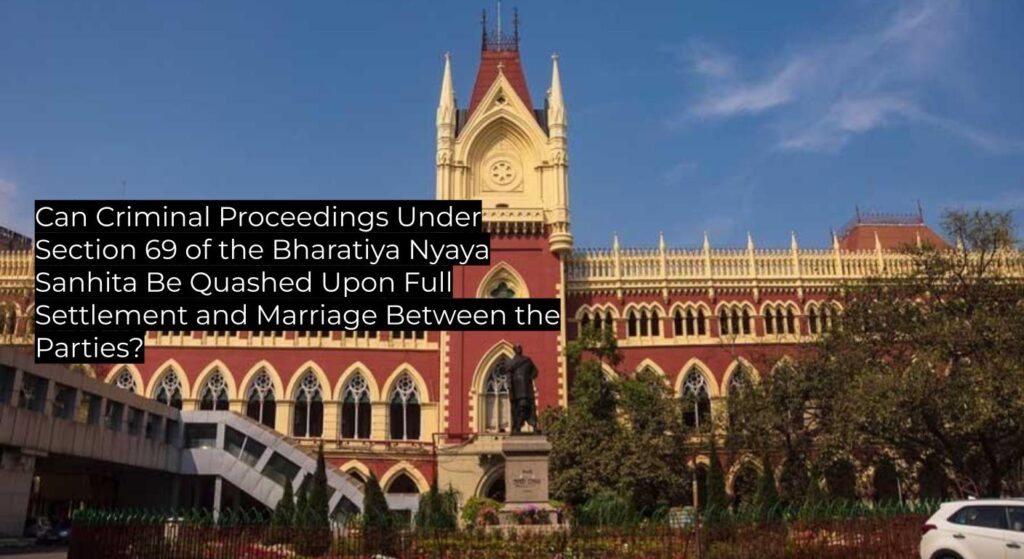
The Calcutta High Court reiterated that criminal proceedings under Section 69 of the BNS may be quashed where the dispute has been fully settled, especially upon marriage and mutual compromise between the parties. The judgment affirms existing precedent, reinforcing the approach adopted in matrimonial and personal disputes, and serves as binding authority for subordinate courts throughout West Bengal.
Summary
| Category | Data |
|---|---|
| Case Name | CRM (A)/2407/2025 of ANUPAM PAUL @ PAL @ ANUP PAUL @ PAL Vs STATE OF WEST BENGAL AND ANR |
| CNR | WBCHCA0314092025 |
| Date of Registration | 10-07-2025 |
| Decision Date | 01-09-2025 |
| Disposal Nature | DISPOSED |
| Judgment Author | HON’BLE JUSTICE JAY SENGUPTA |
| Court | Calcutta High Court |
| Bench | Single Judge |
| Precedent Value | Binding within Calcutta High Court jurisdiction |
| Type of Law | Criminal Law under Bharatiya Nyaya Sanhita, 2023 |
| Questions of Law |
|
| Ratio Decidendi |
Where the very foundation of the FIR under Section 69 BNS, emanating from a private dispute or misunderstanding, has ceased to exist due to an amicable settlement and subsequent marriage between complainant and accused, the High Court may, in the interest of justice, quash the criminal proceedings. The compromise and subsequent registration of marriage between the parties shows that the dispute has been completely resolved. The parties and State confirm the mutual settlement and request quashing. Once proceedings are so quashed, related anticipatory bail applications become infructuous. The Court’s approach remains guided by the interest of justice and supports restoration of harmony between parties in private/matrimonial disputes. |
| Facts as Summarised by the Court |
The criminal case stemmed from a misunderstanding leading to an FIR under Section 69 BNS by the de facto complainant. During the proceedings, parties resolved all differences and got legally married, with the marriage duly registered. The complainant and the State both supported quashing in light of the settlement. |
| Citations | None specified in the judgment. |
Practical Impact
| Category | Impact |
|---|---|
| Binding On | All subordinate courts within Calcutta High Court’s jurisdiction |
| Persuasive For | Other High Courts and potentially for interpretation of compromise scenarios under BNS elsewhere |
| Follows | Approach adopted by the court in cases involving compromise and matrimonial disputes under IPC, now extended to BNS context |
What’s New / What Lawyers Should Note
- The Calcutta High Court confirms its willingness to quash proceedings under Section 69 BNS where private parties fully settle their dispute and marry each other.
- Marriage and settlement between accused and complainant are material developments justifying quashing, provided both parties and the State support the same.
- Related anticipatory bail applications become infructuous once proceedings are quashed.
- Lawyers handling BNS-era cases can cite this judgment as binding precedent for quashing in matrimonial and personal compromise cases.
Summary of Legal Reasoning
- The Court considered reports and recorded submissions by all parties, including the fact that both private parties had voluntarily settled and resolved all disputes leading to the FIR.
- The Court took note that a misunderstanding had led to registration of the original complaint, but this was later clarified.
- The accused and complainant had solemnized and registered their marriage, demonstrating complete reconciliation and resolution of their dispute.
- The Court found that continuance of criminal proceedings after such a settlement would not serve the ends of justice.
- On these grounds, the Court quashed the pending proceedings and dismissed the anticipatory bail application as infructuous.
Arguments by the Parties
Petitioner
- Parties arrived at a settlement and compromise regarding all disputes underlying the FIR.
- The initial dispute resulted from a misunderstanding.
- The accused and the complainant subsequently married and registered their marriage.
Respondent (de facto complainant)
- Supported the petitioner’s contentions.
- Affirmed that the dispute was amicably settled and that the parties were now married.
State
- Informed the Court that the alleged victim had confirmed to the Investigating Officer that the dispute arose from a misunderstanding.
- Noted that the parties are now married and have notified the police of this development.
Factual Background
The proceeding arose from an FIR filed under Section 69 of the BNS at Chakdah Police Station, Nadia, registered as Case No. 98 dated 01.02.2025. The dispute emanated from a misunderstanding between the petitioner and the complainant. During pendency, both parties settled the matter and entered into a registered marriage on 22.08.2025. The complainant and the State both supported the quashing of proceedings on the basis of the compromise.
Statutory Analysis
The judgment concerned interpretation and application of Section 69 of the Bharatiya Nyaya Sanhita, 2023. The judgment confirms that where the offence derives from a private or matrimonial dispute, and the parties have fully settled the same (evidenced here by marriage), the High Court may exercise its powers to quash the criminal proceeding in the interest of justice.
Dissenting / Concurring Opinion Summary
No dissenting or concurring opinions were delivered; the decision was issued by a single judge.
Procedural Innovations
The Court disposed of the anticipatory bail application as infructuous upon quashing of the main criminal proceedings, confirming the procedural approach in such circumstances.
Alert Indicators
- ✔ Precedent Followed – The Court reaffirmed settled legal principles regarding quashing on grounds of full settlement and compromise, in line with past precedent in similar contexts.
Citations
No specific legal citations (SCC, AIR, MANU, or neutral) are referenced in the judgment.