


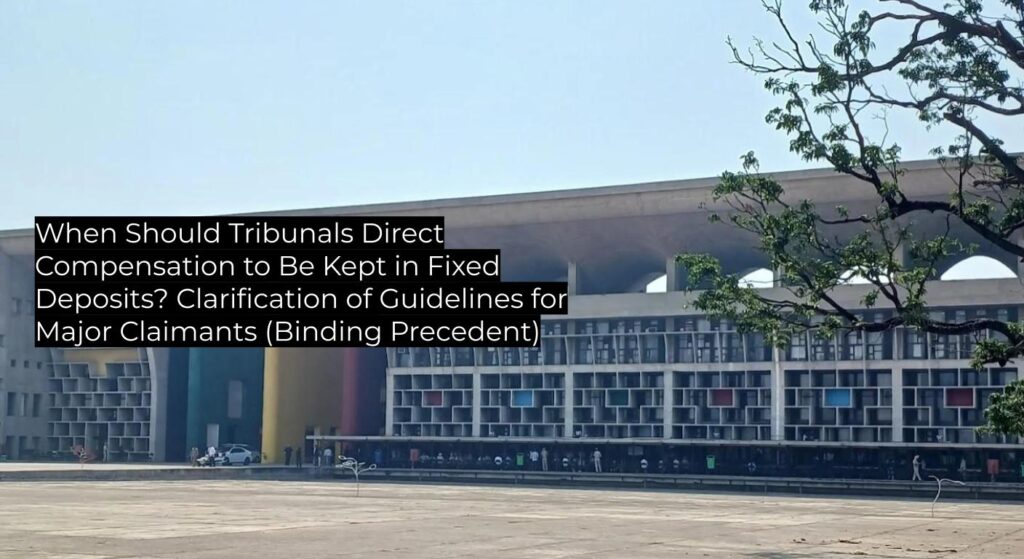
Punjab and Haryana High Court holds that mandatory fixed deposit of compensation for major claimants, in the absence of specific risks, is unnecessary; upholds and elucidates existing Supreme Court and High Court precedent. This provides binding guidance for future compensation disbursal orders in claims tribunals, especially in transport accident cases.
Summary
| Category | Data |
|---|---|
| Case Name | FAO/5232/2025 of CHHINDER PAL KOUR AND OTHERS Vs UNION OF INDIA |
| CNR | PHHC011392792025 |
| Date of Registration | 29-08-2025 |
| Decision Date | 01-09-2025 |
| Disposal Nature | ALLOWED |
| Judgment Author | MR. JUSTICE PANKAJ JAIN |
| Court | High Court of Punjab and Haryana |
| Bench | Single Bench (MR. JUSTICE PANKAJ JAIN) |
| Precedent Value | Binding on subordinate courts and tribunals within jurisdiction of the Punjab & Haryana HC |
| Overrules / Affirms | Affirms and applies previous High Court and Supreme Court guidelines |
| Type of Law | Compensation Law / Procedure before Claims Tribunals |
| Questions of Law | Whether Tribunals should mandatorily direct compensation to be kept in fixed deposits where the claimants are major and not falling in risk categories. |
| Ratio Decidendi |
The Court clarified that directions for keeping compensation in fixed deposits, as per Supreme Court guidelines, are intended to protect minors, persons under disability, widows, and illiterate claimants who are vulnerable to financial exploitation or lack fiscal discipline. Tribunals are not to treat these guidelines as statutory mandates; instead, they must pragmatically assess on a case-to-case basis. Where a claimant is a major and there is no apprehension of financial threat or inability to safeguard funds, fixed deposit directions are unwarranted, and full release is proper. The judgment modifies the tribunal’s order, permitting immediate release to major claimants absent evidence of vulnerability. The illustrative list of vulnerable claimants is not exhaustive, but in all other cases, blanket fixed deposit directions are to be avoided. |
| Judgments Relied Upon |
|
| Logic / Jurisprudence / Authorities Relied Upon by the Court | Referred to prior Supreme Court and High Court guidelines, emphasizing their protective and non-statutory character; considered illustrative rather than exhaustive circumstances for fixed deposit orders. |
| Facts as Summarised by the Court | Tribunal directed 90% of the compensation for major claimants to be kept in fixed deposit, prompting challenge. Appellants challenged the necessity of such a direction, being majors. |
Practical Impact
| Category | Impact |
|---|---|
| Binding On | All subordinate courts and claims tribunals within the jurisdiction of Punjab & Haryana HC |
| Persuasive For | Other High Courts; claims tribunals in similar compensation matters elsewhere |
| Follows | Kamaljit Kaur and others Vs. Union of India (FAO No.4331 of 2024), Supreme Court in General Manager, Kerala State Road Transport Corporation |
What’s New / What Lawyers Should Note
- Reiterates that guidelines for fixed deposit of compensation are not statutory and must not be indiscriminately applied.
- Establishes that major claimants, not falling into vulnerable categories (minors, disabled, widows, illiterate), have a right to full release of awarded compensation.
- Directions for fixed deposit are only justified by specific, case-identified risks, not as a default rule.
- Clarifies that the list of vulnerable claimants (minors, disabled, illiterate, widows) is illustrative and not exhaustive, but general categories of major, competent claimants do not warrant restrictive directions.
Summary of Legal Reasoning
- The Court examined the practice of claims tribunals mandating fixed deposit of compensation, referring to guidelines issued by the Supreme Court in cases such as General Manager, Kerala State Road Transport Corporation.
- Reiterated the principle, elaborated in Kamaljit Kaur (2024), that the aim of such directions is to protect vulnerable claimants—specifically minors, disabled individuals, widows, or illiterate persons who are at risk of financial exploitation or lack fiscal discipline.
- The Court expressly noted that these judicial guidelines are not to be treated as rigid statutory commands but require practical and contextual application.
- The tribunal’s blanket direction for fixed deposit, without individualized assessment of risk or vulnerability for major claimants, was found to be unjustified and was accordingly set aside.
- The Court ordered the compensation to be fully released to major claimants who do not fall into risk categories, holding that such procedural restrictions should only be imposed where factual risk is demonstrated.
Arguments by the Parties
Petitioner
- Challenged the direction of the Tribunal to keep 90% of the compensation in fixed deposit despite all appellants being majors.
- Argued that, being competent adults, they should be entitled to immediate release of compensation.
Respondent
No specific arguments from the respondent are captured in the judgment extract provided.
Factual Background
The appellants challenged the Railway Claims Tribunal’s order which mandated that 90% of compensation awarded be kept in fixed deposits, even though the claimants were all majors. The Tribunal’s intention was to follow protective guidelines. The appellants appealed, asserting their right as adults to receive compensation directly without such restrictions.
Statutory Analysis
- The Court analysed the judicially evolved guidelines (not statutory rules) regarding disbursal of compensation through fixed deposit mechanisms.
- Interpreted these guidelines pragmatically, emphasizing their discretionary and protective nature, not statutory compulsion.
Dissenting / Concurring Opinion Summary
No dissenting or concurring opinions reported or indicated in the judgment.
Procedural Innovations
No new procedural rule or innovation introduced; judgment clarified the application of existing judicial guidelines.
Alert Indicators
- ✔ Precedent Followed – Judgment follows and restates existing guidelines from Supreme Court and Punjab & Haryana High Court.
Citations
- Kamaljit Kaur and others Vs. Union of India, FAO No.4331 of 2024 (Punjab & Haryana HC, decided 12.09.2024)
- General Manager, Kerala State Road Transport Corporation (Supreme Court) (judgment details cited in extract)
- CNR PHHC011392792025