


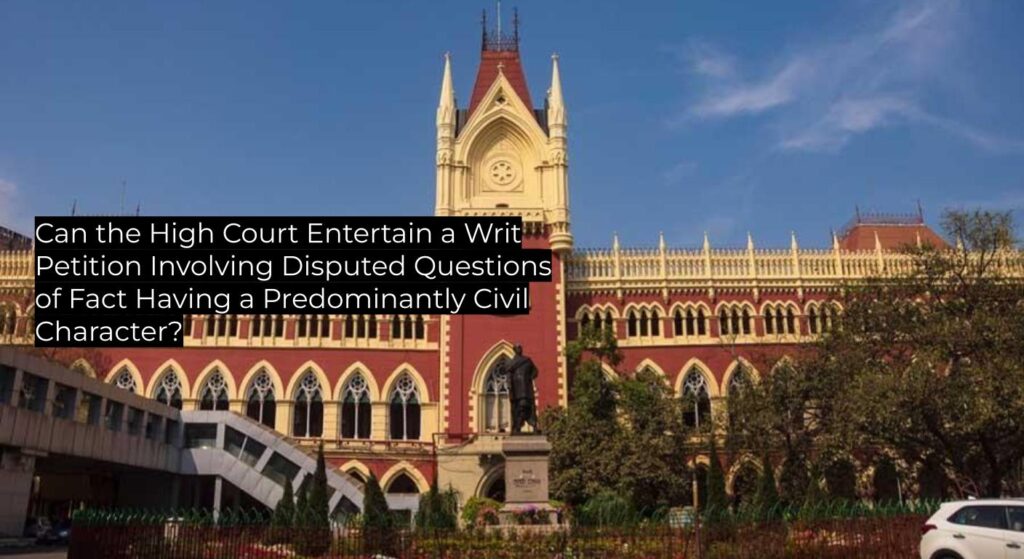
The Calcutta High Court, on dismissal for default, reiterates that writ jurisdiction is not the proper forum to adjudicate matters involving disputed facts of civil nature. This decision upholds the established precedent, confirming that such controversies must be resolved through appropriate civil proceedings, and serves as binding authority for lower courts in similar contexts.
Summary
| Category | Data |
|---|---|
| Case Name | WPA/2557/2020 of GOBARDHAN MAL Vs STATE OF WEST BENGAL & ORS |
| CNR | WBCHCA0068012020 |
| Date of Registration | 07-02-2020 |
| Decision Date | 01-09-2025 |
| Disposal Nature | DISMISSED FOR DEFAULT |
| Judgment Author | HON’BLE JUSTICE PARTHA SARATHI CHATTERJEE |
| Court | Calcutta High Court |
| Precedent Value | Binding on subordinate courts |
| Type of Law | Civil / Constitutional |
| Questions of Law | Whether the High Court can entertain a writ petition involving disputed facts of a civil nature. |
| Ratio Decidendi | The Court held that writ jurisdiction cannot be invoked for matters involving disputed questions of fact with a civil flavour. Only a competent forum, after evaluation of evidence, may adjudicate such issues. Consequently, the writ petition was not entertained. |
| Facts as Summarised by the Court | The petition pertained to a dispute having a civil flavour and involving disputed questions of fact. |
Practical Impact
| Category | Impact |
|---|---|
| Binding On | All subordinate courts within the jurisdiction of the Calcutta High Court |
| Persuasive For | Other High Courts dealing with writ petitions involving disputed facts of civil nature |
What’s New / What Lawyers Should Note
- Reaffirms the established bar on writ jurisdiction in adjudicating factual disputes of a civil character.
- Makes clear that petitioners should approach the competent civil court for matters requiring evidentiary analysis.
- Serves as a succinct precedent for preliminary objections to maintainability of writ petitions encompassing disputed factual matrices of a civil nature.
Summary of Legal Reasoning
- The Court took note that the dispute leading to the institution of the writ petition primarily had a civil flavour.
- It highlighted that the case involved disputed questions of fact.
- The Court reasoned that such disputed facts require evaluation of evidence—a function reserved for trial courts and not for writ courts under Article 226.
- Concluded that it was not appropriate for the writ jurisdiction to be invoked in such circumstances and, accordingly, dismissed the petition.
Factual Background
The writ petition was instituted in respect of a dispute described by the Court as having a “civil flavor” and involving disputed questions of fact. No party appeared before the Court at the time of hearing.
Statutory Analysis
- The judgment reiterates the limitation on the High Court’s writ jurisdiction (presumably under Article 226 of the Constitution), specifically where disputed questions of fact of a civil nature are involved.
- The Court clarified that disputed facts, particularly those requiring evidentiary analysis, are best left to the adjudication of competent civil forums.
Alert Indicators
- ✔ Precedent Followed – The judgment affirms the existing position that writ jurisdiction should not be exercised where civil disputes involving disputed facts are present.