


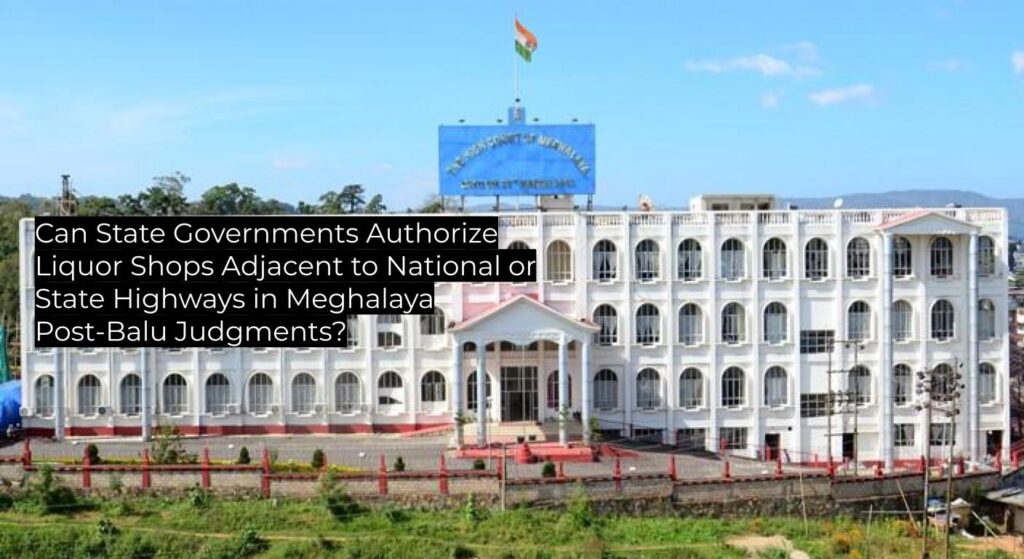
Reaffirmation of Supreme Court Directions with Exemption for Meghalaya and Time-Bound Administrative Review
Summary
| Category | Data |
|---|---|
| Case Name | PIL No. 9/2025 of ARBIANGKAM KHARSOHMAT Vs THE COMMISSIONER AND SECRETARY OF EXCISE GOVERNMENT OF MEGHALAYA AND ANR. |
| CNR | MLHC010011472025 |
| Decision Date | 30-08-2025 |
| Disposal Nature | Disposed Off |
| Judgment Author | Hon’ble Mr. Justice I. P. Mukerji, Chief Justice (Oral) |
| Court | High Court of Meghalaya |
| Bench | Hon’ble Mr. Justice I. P. Mukerji, Chief Justice; Hon’ble Mr. Justice W. Diengdoh |
| Precedent Value | Binding on all subordinate courts and administrative authorities in Meghalaya |
| Overrules / Affirms | Affirms Supreme Court’s Balu judgments; upholds Meghalaya’s exemption from the 500-metre rule |
| Type of Law | Public Interest Litigation; Administrative/Excise Law |
| Questions of Law | Whether the State can grant licences for liquor shops adjoining national or state highways in Meghalaya in view of Supreme Court’s directions in The State of Tamil Nadu v. K. Balu (2016 & 2017). |
| Ratio Decidendi | The High Court held that Supreme Court’s prohibition on liquor shops along highways (paragraph 24 of 2016 Balu judgment) applies to Meghalaya subject to its exemption from the 500 metre rule (paragraph 25 of 2017 Balu judgment). Licensing is a policy matter; local council NOCs must be verified and if granted, a Secretary-level officer must decide within four weeks whether to confirm or modify the NOC, applying all statutory and Supreme Court mandates. |
| Judgments Relied Upon |
|
| Logic / Jurisprudence / Authorities Relied Upon | Directions under Article 142 of the Constitution issued in the Balu judgments; policy deference to the State Government; standard administrative review principles. |
| Facts as Summarised by the Court | The petitioner, a resident and businessman, filed a PIL based on a newspaper article reporting that Pommura Dorbar Shnong proposed NOCs for four-five wine stores adjoining the highway. HNYF opposed. The Excise Department’s licence application was pending, and the Advocate General could not confirm any proposal. |
| Citations | 2025 MLHC 782 (DB) |
Practical Impact
| Category | Impact |
|---|---|
| Binding On | Government of Meghalaya, Excise Department, all subordinate courts in Meghalaya |
| Persuasive For | Other High Courts considering highway-licensing matters |
| Follows | The State of Tamil Nadu rep. by its Secretary, Prohibition & Excise Dept. & ors v. K. Balu (2016 & 2017) |
What’s New / What Lawyers Should Note
- The High Court will overlook formal PIL defects when issues of public interest (excise policy) arise.
- Local council NOCs for liquor licences adjoining highways must be verified by the Excise Department.
- If a village council NOC exists, a Secretary-rank officer must decide within four weeks to confirm or modify it.
- Meghalaya remains exempt from the 500 metre prohibition under paragraph 25 of the 2017 Balu judgment.
- Final decisions must align with both Supreme Court directions and relevant excise enactments.
Summary of Legal Reasoning
- Admissibility of PIL: The Court dispensed with procedural non-compliance, finding public interest grounds sufficient.
- Reliance on Balu Judgments: Cited paragraph 24 (prohibition on highway liquor shops) and paragraph 25 (Meghalaya/Sikkim exemption).
- Policy Deference: Recognised licensing as a State policy domain, best handled by the executive.
- Administrative Process: Directed Excise Department verification of any local NOC, with a four-week Secretary-level review to confirm or amend.
- Article 142 Enforcement: Affirmed that Supreme Court’s orders under Article 142 are binding until implemented by States.
Arguments by the Parties
Petitioner
- Relied on a Meghalaya Times article reporting local council NOCs for four-five highway-adjacent wine stores.
- Asserted detrimental health and safety impacts on villagers.
- Noted HNYF opposition and a pending Excise Department application.
- Relied on Supreme Court’s Balu judgments to prohibit highway liquor shops.
Respondents (State)
- Advocate General unable to confirm existence of any proposal or licence application.
- Interpreted the Balu judgments to allow highway liquor shops subject to conditions and exemptions.
Factual Background
The petitioner, a businessman from East Khasi Hills, filed a PIL under public interest litigation rules, challenging a reported proposal by Pommura Dorbar Shnong to grant no objection certificates for four-five wine stores adjoining a national highway. The Hynniewtrep National Youth Front opposed any new liquor outlets in the village. The petitioner stated that an Excise Department licence application was pending, while the Advocate General could not confirm any such proposal.
Statutory Analysis
- Article 142, Constitution of India: Powers invoked by the Supreme Court to prohibit liquor shops along national and state highways and to grant specific exemptions.
- Excise Legislation: All licensing decisions must comply with Supreme Court directions (“no shop visible, directly accessible, or within 500 m”) and the statutory scheme governing excise licences in Meghalaya, with the 500 m rule waived for the State.
Procedural Innovations
- High Court may waive PIL procedural flaws when public interest is demonstrated.
- Introduction of a time-bound, Secretary-level review (four weeks) for local council NOCs on licensing applications.
- Direct referral mechanism: bench → Excise Department → Secretary → writ petitioner communication.
Alert Indicators
- ✔ Precedent Followed
Citations
- 2025 MLHC 782 (DB)
- Civil Appeal Nos. 12164-12166 of 2016 (15 Dec 2016)
- Civil Appeal Nos. 12164-12166 of 2016 (31 Mar 2017)