


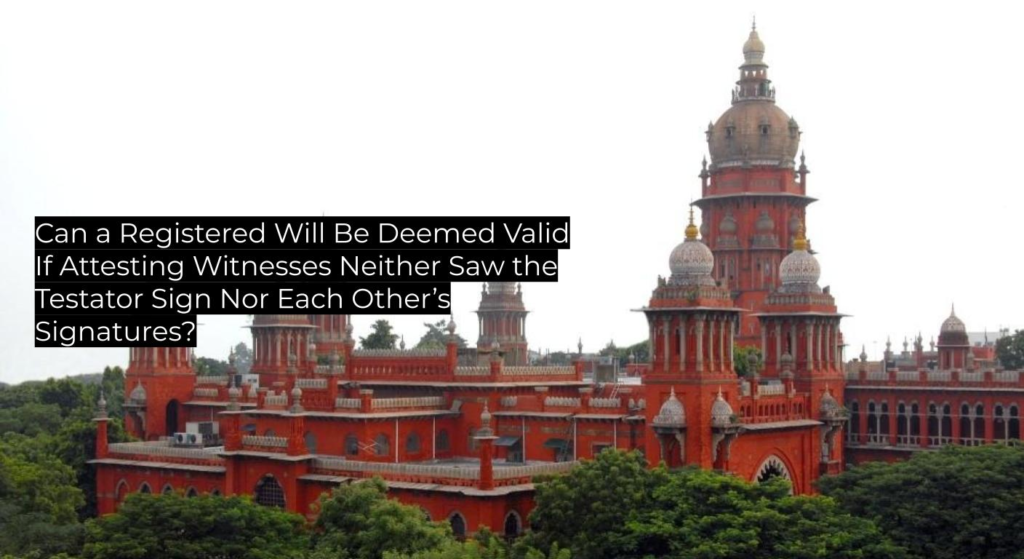
Reaffirming Strict Compliance with Section 63(c) of the Indian Succession Act in Probate Suits
The Madras High Court held that a will, though validly registered, must meet the mandatory attestation requirements under Section 63(c). Witnesses who neither saw the testator sign nor each other sign cannot prove due execution, rendering the will invalid. This decision upholds Supreme Court precedents and is binding authority on all subordinate courts in succession and probate matters.
Summary
| Category | Data |
|---|---|
| Case Name | TOS/19/2002 of G.HEMACHALAM Vs NEELAVATHI |
| CNR | HCMA010067182002 |
| Date of Registration | 03-05-2002 |
| Decision Date | 19-08-2025 |
| Disposal Nature | DISMISSED WITH COST |
| Judgment Author | HONOURABLE MR JUSTICE C.V. KARTHIKEYAN |
| Court | Madras High Court |
| Bench | Single Judge |
| Precedent Value | Binding authority for probate practice |
| Overrules / Affirms | Affirms existing precedent on will execution |
| Type of Law | Civil — Testamentary Succession |
| Questions of Law | Whether registered wills satisfy Section 63(c) attestation requirements |
| Ratio Decidendi |
|
| Judgments Relied Upon |
|
| Logic / Jurisprudence / Authorities |
|
| Facts as Summarised by the Court |
|
| Citations |
|
Practical Impact
| Category | Impact |
|---|---|
| Binding On | All subordinate courts in India |
| Persuasive For | Other High Courts and the Supreme Court in probate and succession disputes |
| Follows |
|
What’s New / What Lawyers Should Note
- Reaffirms that Section 63(c) Indian Succession Act requires attesting witnesses to see the testator sign or receive a personal acknowledgment of the signature.
- A registered will does not enjoy an irrebuttable presumption of due execution if formalities are breached.
- Certified copies of wills are admissible when originals are withheld, but proof of formal execution remains imperative.
- Identification of signatures by a person familiar with attesting witnesses is permissible only when the witnesses are deceased.
- Subsequent wills must independently satisfy attestation requirements; failure invalidates the later instrument and revives the earlier will.
Summary of Legal Reasoning
- Both suits concerned two wills executed by V. Nagammal (1985 and 1988).
- Issues were recast to focus on proof of each will under Section 63(c).
- 1985 Will:
- PW-1 and PW-2 (advocate) proved preparation, execution and attestation in compliance with Section 63(c).
- Original was withheld by opponent; certified copy admitted.
- Will held genuine and probate granted.
- 1988 Will:
- DW-2 and DW-3 (attesting witnesses) admitted they did not see testatrix or each other sign.
- Fundamental non-compliance with Section 63(c) fatal.
- Will invalid and probate dismissed.
- Supreme Court precedents (Murthy and Girja Datt Singh) require strict attestation; applied here.
Arguments by the Parties
Petitioner (T.O.S. 92/2013 – G. Somasundaram)
- 1985 will was fairly drafted and executed by family-retained advocate; attesting witnesses properly identified.
- Certified copy admissible since original was withheld by defendant.
- 1988 will was subsequent, but later proved invalid.
Respondent (T.O.S. 92/2013 – G. Hemachalam)
- 1985 will was revoked by 1988 instrument; probate of earlier will should be rejected.
Petitioner (T.O.S. 19/2002 – G. Hemachalam)
- 1988 will rationally disposes assets; daughters well provided; testatrix was of sound mind.
- Attesting witnesses’ delayed testimony should not be fatal.
Respondent (T.O.S. 19/2002 – G. Somasundaram & Others)
- 1988 will attestation failed: witnesses did not see signing; non-compliance with Section 63(c).
- Suspicious circumstances and undue influence.
Factual Background
V. Nagammal executed two registered wills—one on 16 Sept 1985 and another on 30 Nov 1988. Her sons, G. Somasundaram and G. Hemachalam, filed separate probate suits to prove each will. Family members contested ownership, revocation and attestation formalities. Trial evidence centered on whether attesting witnesses saw the testatrix sign as required by Section 63(c). The High Court recast issues to focus solely on statutory proof requirements.
Statutory Analysis
- Section 63(c), Indian Succession Act, 1925: mandates two or more witnesses must see the testator sign or receive personal acknowledgment, and each must sign in the testator’s presence.
- Sections 222 & 276, Indian Succession Act: enable grant of probate.
- Order XIV Rule 1, CPC: framing and recasting of issues based on pleadings and evidence.
- Registration presumption (Section 68, Indian Evidence Act) is rebuttable by contradictory witness admissions.
Procedural Innovations
Judge recast issues after hearing arguments and evidence under Order XIV Rule 1 CPC, focusing on genuine disputes and avoiding redundant questions without causing prejudice.
Alert Indicators
- Precedent Followed
Citations
- 2025:MHC:2003 (Madras High Court)
- Murthy & Ors. v. C. Saradambal & Ors., (2022) 3 SCC 209, para 49
- Girja Datt Singh v. Gangotri Datt Singh, AIR 1955 SCC 346
- Indian Succession Act, 1925: Sections 63(c), 222, 276
- Order XIV Rule 1, CPC