


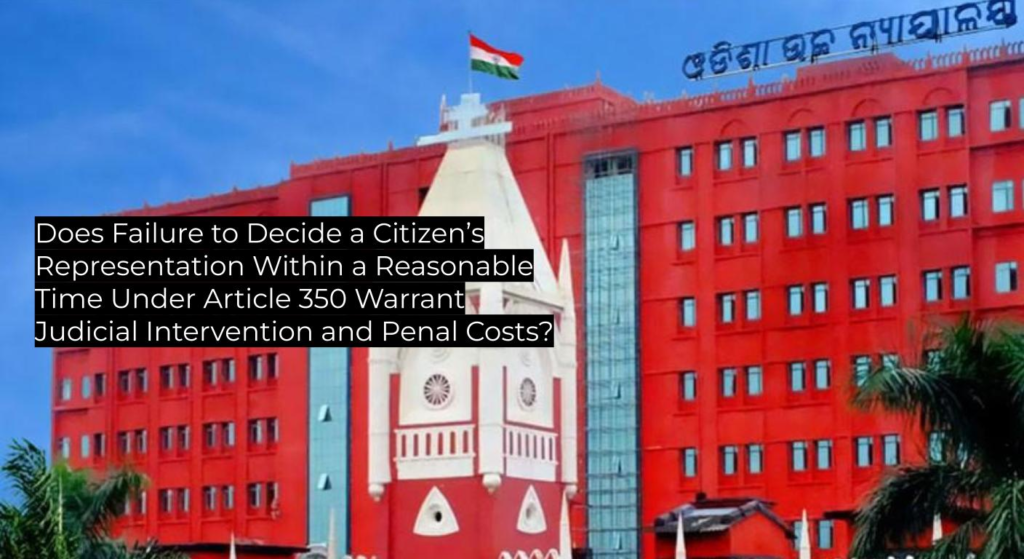
The Orissa High Court reaffirms the constitutional mandate under Article 350, directing time-bound disposal of grievances with personal penal cost for officials; serves as binding authority for petitioners seeking redressal of administrative delays.
Summary
| Category | Data |
|---|---|
| Case Name | WP(C)/22507/2025 of DIBYA CHANDRA DEHURY Vs STATE OF ODISHA |
| CNR | ODHC010565452025 |
| Date of Registration | 12-08-2025 |
| Decision Date | 18-08-2025 |
| Disposal Nature | Disposed Off |
| Judgment Author | Justice Dixit Krishna Shripad |
| Court | Orissa High Court |
| Bench | Single Judge |
| Questions of Law | Whether non-decision of a representation under Article 350 violates the constitutional mandate to decide grievances on merits within a reasonable period? |
| Ratio Decidendi | The court held that a citizen’s grievance raised under Article 350 must be decided on merits within a reasonable time. Failure or undue delay empowers the High Court under its constitutional and writ jurisdiction to issue time-bound directions. The court may also impose personal penal costs on erring officials to ensure compliance. All contentions remain open for adjudication. |
| Logic / Jurisprudence / Authorities Relied Upon by the Court | Invocation of Article 350 of the Constitution requiring prompt decision-making on citizen grievances; earlier direction by a Coordinate Bench to file representation under State transfer policy. |
| Facts as Summarised by the Court | The petitioner sought transfer on health grounds, was directed by a Coordinate Bench to make a fresh representation. Despite online filing, no decision was communicated. The petitioner invoked Article 350, and the court directed OPs to decide within six weeks, warning of penal costs for delay. |
Practical Impact
| Category | Impact |
|---|---|
| Binding On | All executive authorities responsible for disposing representations under Article 350. |
| Persuasive For | Other High Courts considering delays in administrative grievance redressal. |
What’s New / What Lawyers Should Note
- Reaffirms that representations invoking Article 350 must be decided on merits within a “reasonable period.”
- Confirms High Court’s power under writ jurisdiction to impose time-bound directives when executive authorities delay.
- Introduces personal penal costs against officials for unreasoned or delayed decisions.
- Keeps all substantive contentions open, preserving the petitioner’s right to full adjudication.
Summary of Legal Reasoning
- Background order: A Coordinate Bench had directed the petitioner to file one more representation under the State’s transfer policy.
- Invocation of Article 350: The petitioner argued that non-disposal violates the constitutional obligation to decide grievances within a reasonable period.
- Court’s remit: The High Court, under its writ jurisdiction, may enforce Article 350’s mandate where executive inaction persists.
- Time-bound directive: The court ordered disposal of the representation within six weeks, inclusive of time to inform the petitioner.
- Penal costs: To deter further delay, officials face personal penal costs for non-compliance, recoverable from them personally.
- Preservation of rights: All contentions remain open, and the executive may request information from the petitioner but must not use it to delay.
Arguments by the Parties
Petitioner
- Alleged health grounds warranting transfer.
- Representation filed online as directed; no decision communicated.
- Invoked Article 350 to compel a decision on merits within a reasonable time.
Opposite Parties
- AGA submitted that jurisdictional officials would be instructed to consider the representation time-bound.
- Sought liberty to raise all contentions at the decision-making stage.
Factual Background
The petitioner, an employee seeking inter-place transfer on health grounds, was earlier directed by a Coordinate Bench on 27 January 2025 to file a fresh representation under the State’s transfer guidelines. Despite filing online, no decision was communicated by the concerned department, prompting invocation of Article 350’s requirement for prompt grievance disposal. The High Court disposed the writ petition on 18 August 2025, directing decision within six weeks and warning of personal penal costs for delay.
Statutory Analysis
- Article 350, Constitution of India: Imposes a constitutional duty on appropriate authorities to decide citizens’ grievances on merits within a reasonable period.
- Writ jurisdiction: The High Court can enforce Article 350 by issuing mandamus for time-bound disposal.
Procedural Innovations
- Imposition of personal penal costs on government officials for undue delay in disposing representations.
- Explicit inclusion of time taken to communicate decisions in the overall compliance period.
Alert Indicators
- ✔ Precedent Followed – Upholds the established constitutional mandate under Article 350 for prompt grievance disposal.