


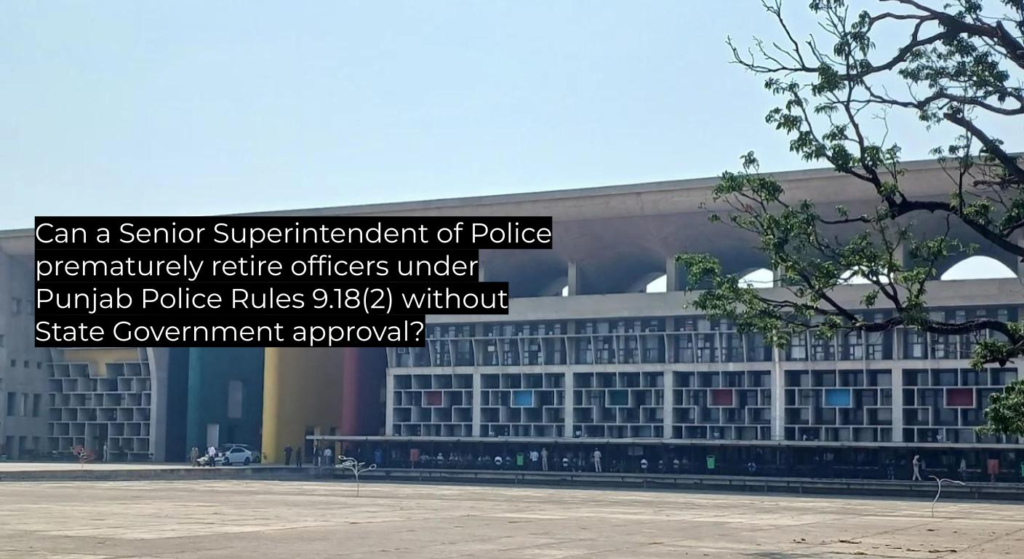
The High Court of Punjab and Haryana held that only an Inspector General of Police, with prior sanction of the State Government, can invoke Rule 9.18(2) PPR to retire officers after ten years’ service, setting aside SSP orders for lack of competence and procedural fairness and reaffirming mandatory approval and hearing requirements.
Summary
| Category | Data |
|---|---|
| Case Name | CWP/22931/2017 of Rakesh Roshan vs State of Punjab & Ors |
| CNR | PHHC010923162017 |
| Decision Date | 09-05-2022 |
| Disposal Nature | Allowed |
| Judgment Author | Jaishree Thakur, J. |
| Court | High Court of Punjab and Haryana |
| Bench | Single-judge bench |
| Question of Law | Whether Rule 9.18(2) of the Punjab Police Rules empowers a Senior Superintendent of Police to retire an officer prematurely without prior State Government approval. |
| Ratio Decidendi | The power to prematurely retire a police officer under Rule 9.18(2) PPR vests only in an officer who has obtained prior sanction of the State Government—typically the Inspector General of Police. A Senior Superintendent of Police, lacking delegated competence and absent any show-cause notice or hearing, cannot exercise that power. Any order passed in breach of these mandatory requirements is void. The petitions were accordingly allowed and the orders set aside. |
Practical Impact
| Category | Impact |
|---|---|
| Binding On | All subordinate police authorities in Punjab and Haryana |
What’s New / What Lawyers Should Note
- Reaffirms that Rule 9.18(2) PPR requires prior sanction of the State Government for premature retirement of officers with ten years’ qualifying service.
- Clarifies that only an Inspector General of Police (or an authority expressly empowered) may invoke Rule 9.18(2), not an SSP.
- Confirms the necessity of issuing a show-cause notice and affording an opportunity to be heard before passing a retirement order.
- Validates challenges to retirement orders procured in breach of service-rule procedures.
Summary of Legal Reasoning
- Rule Interpretation: Examined Rule 9.18(2) PPR, which mandates State Government sanction before retiring an officer with ten years’ service.
- Competence: Held that neither the Senior Superintendent of Police nor any authority below the IG is competent to pass such orders.
- Procedural Fairness: Emphasized the requirement of a show-cause notice and opportunity of hearing as integral to the rule.
- Invalidity of Orders: Concluded that orders passed without competence or hearing are void.
- Remand: Directed respondents to reconsider the petitioners’ cases afresh within three months, adhering strictly to the rule.
Arguments by the Parties
Petitioner
- Impugned orders were based solely on service-record scrutiny without any show-cause notice or hearing.
- Rule 9.18(2) PPR requires prior State Government approval for premature retirement after ten years’ service.
- The SSP lacks competence to invoke Rule 9.18(2) or pass retirement orders.
Factual Background
Rakesh Roshan and Lakhwinder Singh, police officers in Pathankot and Gurdaspur, were retired prematurely by orders dated 04.07.2017 and 24.06.2017 respectively, issued by the Senior Superintendents of Police. Those orders cited “public interest” but did not comply with Rule 9.18(2) PPR—no state sanction, no show-cause notice, no hearing. Writ petitions challenged the competence of the issuing authorities and the breach of procedural safeguards. The High Court set aside the retirement orders and remanded for fresh consideration.
Statutory Analysis
- Rule 9.18(2), Punjab Police Rules:
- Applies to officers with ten years’ qualifying service.
- Mandates prior approval of the State Government before premature retirement.
- Empowers typically the Inspector General of Police to propose and obtain sanction.
- Procedural mandate of issuing show-cause notices and hearing before retirement is integral to the rule’s operation.
Alert Indicators
- ✔ Precedent Followed – The decision reaffirms existing requirements under the Punjab Police Rules rather than breaking new ground.
Citations
No external citations or reported references were relied upon in the judgment.